



Top 7 Key Components of IoT in Healthcare
Learn about the seven essential components of IoT in healthcare and how sensors, connected medical devices, communication networks, cloud computing, AI, and security systems work together to improve patient monitoring and digital healthcare services.
7 Key Components of IoT in Healthcare: How Connected Technology Works
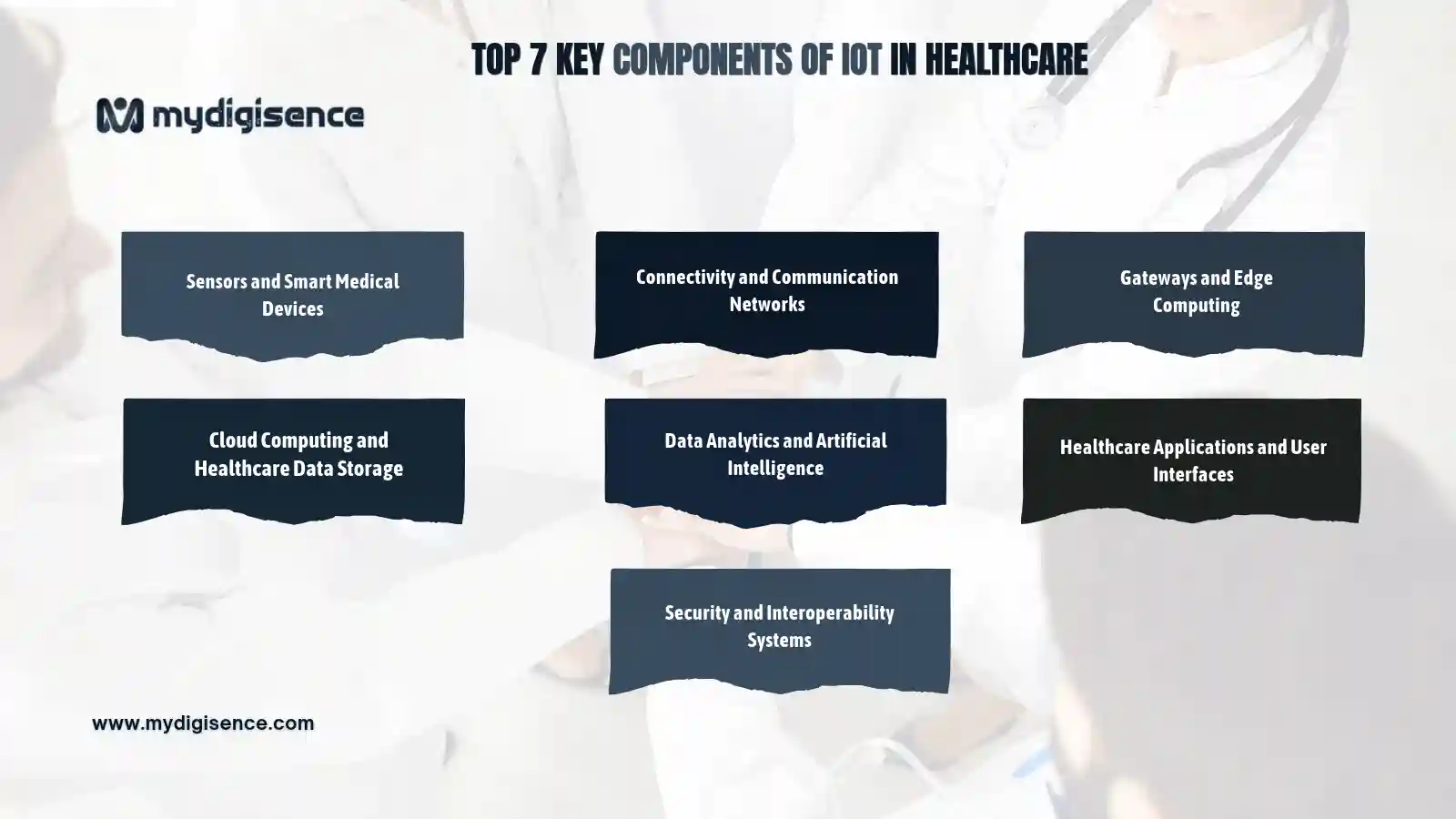
The Top 7 key components of IoT in healthcare form the foundation of connected healthcare systems that collect, transmit, process, and analyze patient information. These components include smart medical devices and sensors, connectivity networks, gateways and edge computing, cloud platforms, data analytics, healthcare applications, and security systems.
Explore Our Health & Medical Businesses Listing
The Internet of Things (IoT) in healthcare is also known as the Internet of Medical Things (IoMT). It connects medical equipment, wearable devices, healthcare professionals, patients, and digital platforms to support continuous health monitoring and more informed clinical decisions.
From smartwatches and glucose monitors to connected hospital equipment and remote patient monitoring systems, IoT technology is changing how healthcare information is collected and managed.
Quick Answer: What Are the 7 Key Components of IoT in Healthcare?
The seven key components of IoT in healthcare are:
Sensors and smart medical devices: Collect patient health information such as heart rate, blood pressure, glucose levels, and oxygen saturation.
Connectivity and communication networks: Transfer health information using Wi-Fi, Bluetooth, cellular networks, and other communication technologies.
Gateways and edge computing: Process and filter information near the source before sending it to cloud platforms.
Cloud computing and data storage: Store and manage large volumes of healthcare information.
Data analytics and artificial intelligence: Analyze collected information to identify patterns, trends, and potential health risks.
Healthcare applications and user interfaces: Allow doctors, nurses, patients, and caregivers to access and understand health information.
Security and interoperability systems: Protect sensitive medical information and enable different devices and healthcare platforms to exchange data.
Together, these components create an interconnected healthcare ecosystem that supports remote patient monitoring, smart hospitals, digital health services, and connected medical equipment.
Key Takeaways
IoT in healthcare connects medical devices, sensors, software, and healthcare systems.
Sensors collect real-time physiological and environmental information.
Communication networks transfer information between devices and healthcare platforms.
Edge computing helps process information closer to connected devices.
Cloud computing supports healthcare data storage and accessibility.
AI and data analytics help identify patterns in patient information.
Security and interoperability are essential for protecting medical data and connecting different healthcare systems.
Remote patient monitoring is one of the major applications of healthcare IoT.
1. Sensors and Smart Medical Devices
Sensors and smart medical devices are the first and most important components of IoT in healthcare. They collect information from patients, medical equipment, and healthcare environments.
These devices convert physical or biological measurements into digital information that can be transmitted to connected systems.
Types of Healthcare IoT Sensors
Heart rate sensors: Measure the patient's heart rate and help monitor cardiovascular activity.
Blood pressure sensors: Measure blood pressure and support monitoring for patients who require regular readings.
Glucose sensors: Continuous glucose monitoring devices measure glucose levels and help people with diabetes track changes.
Temperature sensors: Monitor body temperature and help identify changes that may require medical attention.
Oxygen saturation sensors: Pulse oximeters measure blood oxygen saturation (SpO2) and pulse rate.
Motion and activity sensors: Track physical movement, activity levels, and potential falls.
Examples of Smart Medical Devices
Smartwatches and fitness trackers
Continuous glucose monitors
Smart blood pressure monitors
Connected pulse oximeters
Wearable ECG monitors
Smart inhalers
Connected infusion pumps
For example, a patient wearing a connected heart monitor can have relevant heart activity recorded and transmitted to an authorized healthcare monitoring system.
The information can help healthcare professionals review trends and decide whether further assessment is needed.
2. Connectivity and Communication Networks
Collecting medical information is not enough. Healthcare IoT devices must also communicate with other devices, applications, and healthcare systems.
Connectivity and communication networks make this possible.
They transfer information from sensors and medical equipment to gateways, cloud platforms, and authorized healthcare applications.
Common Communication Technologies in Healthcare IoT
Wi-Fi: Connects medical devices to local wireless networks in hospitals, clinics, and homes.
Bluetooth Low Energy (BLE): Supports communication between wearable devices, smartphones, and other low-power medical equipment.
Cellular networks: Allow connected healthcare devices to transmit information over mobile networks, particularly when Wi-Fi is unavailable.
5G: Can support high-bandwidth and low-latency healthcare applications where network coverage, device capabilities, and system design permit.
Zigbee: A low-power wireless communication technology that can be used in certain connected healthcare and building environments.
Near Field Communication (NFC): Supports short-range communication and identification in suitable healthcare applications.
The choice of communication technology depends on device power consumption, transmission range, reliability, bandwidth, and healthcare requirements.
For example, a wearable glucose monitoring system may use Bluetooth to communicate with a smartphone, which then transfers relevant information to a connected healthcare platform.
3. Gateways and Edge Computing
Gateways and edge computing systems act as an important connection between medical devices and cloud infrastructure.
A healthcare IoT environment may contain hundreds or thousands of connected devices. Sending every raw measurement directly to the cloud can increase network traffic and processing requirements.
Gateways help collect and forward information from multiple devices.
Main Functions of Healthcare IoT Gateways
Connect different medical devices.
Translate communication protocols when required.
Filter and organize collected information.
Forward information to cloud platforms.
Support device authentication and network management.
What Is Edge Computing in Healthcare?
Edge computing processes information closer to the device where it is generated rather than sending every task to a distant cloud server.
For example, a connected patient monitoring system can use edge processing to identify a reading that crosses a predefined threshold and trigger a local notification.
This can reduce communication delays for suitable applications.
However, critical medical alerts still require validated clinical workflows, reliable systems, and appropriate healthcare professional oversight.
You May Like Also: Business Listing Platform for Healthcare
4. Cloud Computing and Healthcare Data Storage
Cloud computing is another essential component of IoT in healthcare.
Connected medical devices generate large amounts of information. Cloud platforms provide computing and storage infrastructure to manage this information and make it accessible to authorized users.
Key Functions of Cloud Computing in Healthcare
Healthcare data storage: Stores information collected from connected medical devices and monitoring systems.
Remote accessibility: Allows authorized healthcare professionals to access relevant information from different locations.
Data integration: Supports the integration of information from multiple connected devices and healthcare applications.
Scalability: Provides infrastructure that can expand as healthcare organizations add more devices and users.
Backup and recovery: Supports data protection and recovery strategies when properly configured.
Role of Cloud Platforms in Healthcare IoT
For example, a patient using a connected blood pressure monitor may generate readings several times a day.
The device sends readings through a connected smartphone or gateway to a healthcare platform. The platform stores the information so authorized healthcare professionals can review readings over time.
Cloud computing therefore supports remote patient monitoring, digital health applications, and connected hospital operations.
Healthcare organizations must also consider data residency, access controls, encryption, backup policies, and applicable privacy regulations when selecting cloud infrastructure.
5. Data Analytics and Artificial Intelligence
Collecting healthcare data is useful, but understanding that information is equally important.
Data analytics and artificial intelligence (AI) help transform large volumes of raw medical information into meaningful insights.
IoT healthcare systems can generate continuous information about heart rate, glucose levels, oxygen saturation, movement, sleep patterns, and other measurements.
Analytics tools help organize and interpret these readings.
How Data Analytics Works in Healthcare IoT
Collect information from connected medical devices.
Organize and process incoming data.
Identify patterns and unusual readings.
Generate reports and visualizations.
Support healthcare professionals in reviewing patient information.
Role of Artificial Intelligence in Healthcare IoT
AI and machine learning can help analyze patterns in patient information and support certain predictive or classification tasks.
For example, an AI-enabled monitoring system may analyze changes in heart rate and other relevant measurements to flag patterns for clinical review.
Other applications include:
Patient monitoring analytics
Medical image analysis
Predictive maintenance of medical equipment
Hospital resource planning
Personalized health monitoring
Clinical decision-support applications
AI-generated outputs should not automatically be treated as medical diagnoses. Their reliability depends on data quality, clinical validation, intended use, and human oversight.
MyDigiSence helps businesses and professionals establish their digital presence and showcase their services. Healthcare technology companies and software service providers can use business platforms to present their expertise and connect with potential business customers.
6. Healthcare Applications and User Interfaces
Healthcare applications and user interfaces connect IoT technology with the people who use it.
Even when sensors collect accurate information and cloud platforms store it properly, healthcare professionals and patients need accessible ways to understand that information.
Applications present relevant data through dashboards, notifications, reports, and monitoring interfaces.
Common Healthcare IoT Applications
Remote Patient Monitoring: Allows authorized healthcare teams to review patient measurements collected outside traditional healthcare facilities.
Electronic Health Records (EHR): Help healthcare organizations maintain and manage patient health information. IoT integrations can make relevant device data available within connected workflows.
Telemedicine Applications: Support remote consultations and can work alongside connected health monitoring devices.
Smart Hospital Management: Helps healthcare facilities monitor connected medical equipment, environmental conditions, and certain operational processes.
Medication Management: Connected medication dispensers and smart packaging can support medication tracking and reminders.
Patient Monitoring Dashboards: Display information such as vital signs, alerts, and historical readings.
Why User Interfaces Matter
A well-designed interface helps users understand healthcare information without unnecessary complexity.
Doctors need clinically relevant information, while patients may need simple explanations, reminders, and access to their own monitoring records.
Healthcare applications should also consider accessibility, usability, data accuracy, and appropriate user permissions.
7. Security and Interoperability Systems
Security and interoperability are essential components of a reliable healthcare IoT ecosystem.
Connected medical devices transmit sensitive information across networks and digital platforms. Without appropriate safeguards, this information may be exposed to unauthorized access, misuse, or cyberattacks.
Important Healthcare IoT Security Measures
Data encryption: Helps protect medical information during transmission and storage.
Authentication: Ensures that users and devices are properly identified before accessing systems.
Access control: Restricts sensitive information to authorized users.
Network security: Helps protect connected devices and healthcare infrastructure from unauthorized access.
Software updates: Address security vulnerabilities and maintain device reliability.
Continuous monitoring: Helps identify suspicious activities and potential security incidents.
What Is Interoperability in Healthcare IoT?
Interoperability means that different healthcare devices, applications, and information systems can exchange and use information effectively.
For example, a connected patient monitor may collect vital signs, while an Electronic Health Record system stores relevant patient information.
Standards and technologies such as HL7, FHIR, and suitable device communication protocols can help support healthcare data exchange.
However, interoperability also requires consistent data formats, agreed terminology, compatible interfaces, and appropriate governance.
Security should be considered throughout the device lifecycle, from design and development to deployment, maintenance, and retirement.
How Do the 7 Components of IoT in Healthcare Work Together?
The seven components work as an interconnected system. Each component performs a specific function, but the complete healthcare IoT system depends on their coordination.
Consider a remote patient monitoring example:
A wearable medical device measures a patient's heart rate and oxygen saturation.
Sensors convert these measurements into digital information.
Bluetooth or another communication technology transfers the information to a connected gateway.
Edge computing processes relevant information when required.
Cloud infrastructure stores and manages the measurements.
Analytics software identifies trends and potential abnormalities.
A healthcare application presents relevant information to authorized professionals.
Security and interoperability controls protect information and support communication between systems.
This process allows healthcare professionals to review patient information remotely and follow appropriate clinical procedures.
Real-World Applications of IoT in Healthcare
Healthcare IoT is used across different medical and operational environments.
Application | How IoT helps |
|---|---|
Remote patient monitoring | Collects patient measurements outside hospitals |
Diabetes management | Supports continuous glucose monitoring |
Cardiac monitoring | Tracks relevant heart activity |
Smart hospitals | Connects medical equipment and operational systems |
Elderly care | Supports activity monitoring and fall detection |
Medication management | Helps track medication use and reminders |
Medical equipment monitoring | Tracks equipment status and maintenance requirements |
Telemedicine | Complements remote consultations with health data |
These applications can support healthcare delivery, but their effectiveness depends on clinical suitability, device accuracy, connectivity, and proper implementation.
Challenges of Implementing IoT in Healthcare
Despite its potential, healthcare IoT comes with several technical and operational challenges.
1. Data Privacy
Healthcare organizations must protect sensitive patient information and follow applicable privacy and data protection requirements.
2. Cybersecurity Threats
Connected devices can introduce additional security risks, particularly when software is outdated or devices use weak authentication.
3. Interoperability Problems
Devices from different manufacturers may use different communication protocols and data formats.
4. Network Reliability
Healthcare applications that depend on continuous connectivity may experience problems when networks become unavailable.
5. Implementation Costs
Medical IoT deployments require investment in devices, networks, software, infrastructure, integration, and maintenance.
6. Device Accuracy and Reliability
Medical information must be collected using suitable, validated devices. Poor-quality measurements can affect the usefulness of monitoring systems.
Healthcare organizations should evaluate these challenges before deploying connected medical technologies.
Future of IoT in Healthcare
The future of IoT in healthcare will involve greater integration of connected medical devices, artificial intelligence, edge computing, cloud infrastructure, and digital health platforms.
Some important developments include:
AI-powered patient monitoring: More advanced analysis of health information collected from connected devices.
Wearable medical technology: Increasing use of devices that monitor relevant physiological measurements.
Hospital-at-Home services: Connected technologies supporting selected healthcare services outside traditional hospital settings.
Edge AI: Processing certain healthcare information closer to the source.
Interoperable healthcare systems: Better integration between medical devices and digital health records.
Smart medical equipment: More connected systems for monitoring equipment performance and maintenance.
These developments may support more connected and data-driven healthcare services. Their adoption will depend on clinical evidence, safety, privacy, affordability, and regulatory requirements.
Conclusion
The Top 7 key components of IoT in healthcare are sensors and smart medical devices, connectivity networks, gateways and edge computing, cloud computing, data analytics and AI, healthcare applications, and security and interoperability systems.
Together, these technologies create connected healthcare environments that support remote patient monitoring, smart hospitals, digital health applications, and better access to relevant medical information.
However, successful healthcare IoT implementation requires more than connecting medical devices to the internet. Data security, interoperability, device accuracy, reliable infrastructure, and clinical oversight are equally important.
As healthcare technology continues to evolve, understanding these components will help healthcare organizations, technology companies, and software developers build more reliable connected healthcare solutions.
You May Like Also: How B2B Platforms Support Freelancers & Professionals
Our Social Account:
Written by
Shivam Thakur
Nov 4, 2026
More from the blog

Clutch vs MyDigiSence Plans: Which Is Better?
Clutch vs MyDigiSence plans: compare pricing, free business listings, verification, customer reviews, lead management, and business visibility. Discover which platform offers better value for startups, agencies, freelancers, and Indian businesses.

Top 10 Quality of Property Broker
What makes a property broker reliable? Explore 10 essential qualities of a professional real estate broker and learn how to identify the right person for buying, selling, or renting property.