
How AI Is Changing B2B Marketplace Platforms
AI is transforming B2B marketplace platforms by making business search, buyer-seller matching, lead qualification, recommendations, and service discovery smarter and more efficient. Learn how AI is shaping the future of B2B marketplaces and how MyDigiSence supports online business discovery.
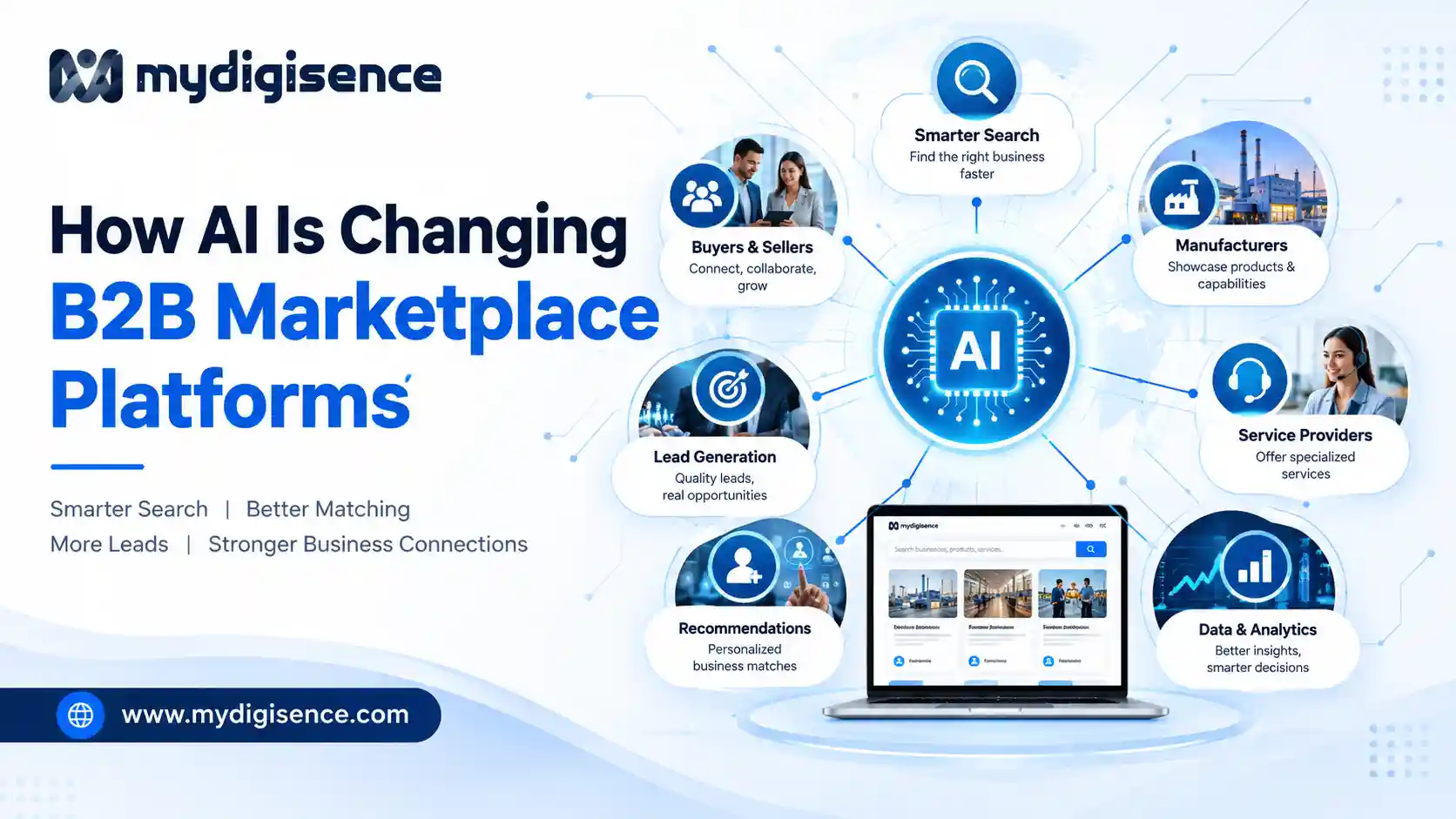
Artificial intelligence is changing how businesses discover suppliers, evaluate products, generate leads, and manage B2B relationships. Traditional B2B platforms mainly helped businesses list products and search for companies, but AI is making these platforms more intelligent, personalized, and efficient.
Today, AI can help understand search intent, recommend relevant businesses, organize large amounts of marketplace data, automate repetitive tasks, and improve the buyer-seller matching process. As B2B purchasing becomes increasingly digital, AI is becoming an important part of the modern B2B marketplace platform.
For platforms such as MyDigiSence, AI represents an opportunity to make business discovery simpler by helping users explore businesses and professionals online, discover relevant services, and find potential business connections more efficiently.
AI Overview: How Is AI Changing B2B Marketplace Platforms?
AI is changing B2B marketplace platforms by improving search, business recommendations, buyer-seller matching, lead qualification, personalization, automation, and data analysis. Instead of relying only on keywords and basic business listings, AI can understand user intent and help businesses discover more relevant suppliers, buyers, professionals, products, and services. This makes B2B marketplaces more efficient for both buyers and sellers while reducing the time required to find relevant business opportunities.
What Role Does AI Play in a B2B Marketplace Platform?
AI acts as an intelligent layer between marketplace users and the large amount of business information available on a platform.
A traditional marketplace may require users to search through multiple categories, listings, and profiles. AI can make this process more efficient by analyzing what a user is looking for and identifying potentially relevant results.
For example, instead of searching separately for manufacturers, suppliers, or service providers, a user could describe their requirement in natural language. An AI-powered system can then interpret the requirement and return more relevant business options.
This can improve the overall journey:
Business Requirement → AI Understanding → Relevant Results → Business Discovery → Inquiry → B2B Connection
1. Smarter Business Search
Search is one of the most important functions of any B2B marketplace.
Traditional search generally depends on keywords, categories, locations, and filters. AI can make search more context-aware by understanding the meaning behind a query.
For example, a buyer searching for "bulk packaging supplier for food products" may be looking for businesses with specific manufacturing capabilities rather than companies that simply contain the word "packaging" in their profile.
AI can potentially consider:
Search intent
Business category
Products and services
Location
Industry
Business descriptions
Previous interactions
User preferences
This can make business discovery more relevant.
You May Like Also: B2B Marketplace Platform for MSMEs: Everything You Need to Know
2. Better Buyer-Seller Matching
One of the biggest opportunities for AI in B2B marketplaces is intelligent matching.
A marketplace contains two major groups: businesses offering products or services and businesses looking for them.
AI can analyze information from both sides and identify potential matches based on factors such as product requirements, industry, location, service category, and business needs.
For example, if a buyer needs a particular industrial component, an AI system could identify manufacturers and suppliers whose profiles indicate that they offer the relevant product.
This can reduce the time buyers spend manually searching through unrelated listings.
3. Personalized Business Recommendations
Different users have different requirements.
A manufacturer may be interested in logistics providers, distributors, and wholesale buyers. A retailer may be looking for manufacturers and suppliers. A professional may want to connect with businesses that need their expertise.
AI can help personalize recommendations based on user behavior and marketplace information.
Instead of showing the same businesses to everyone, an intelligent marketplace can potentially prioritize businesses and services that are more relevant to each user's requirements.
4. AI-Powered Lead Qualification
Not every inquiry has the same value.
Some inquiries may come from businesses that are actively looking to purchase, while others may simply be researching a product or service.
AI can help businesses analyze inquiries and identify signals that may indicate stronger purchase intent.
For example, an inquiry containing information about:
Required quantity
Product specifications
Delivery location
Budget
Expected timeline
Business requirements
may provide stronger buying signals than a general request for information.
AI-assisted lead qualification can help sales teams prioritize their follow-up efforts.
5. Automated Business Profile Improvements
A business profile is an important part of a B2B marketplace.
However, many businesses create incomplete profiles or use descriptions that do not clearly explain what they offer.
AI can assist businesses with tasks such as:
Writing clearer business descriptions
Organizing product information
Suggesting relevant categories
Improving listing content
Identifying missing information
Creating structured service descriptions
This can help businesses present their offerings more clearly to potential customers.
6. Faster Product and Service Discovery
B2B buyers often need to research multiple businesses before making a decision.
AI can simplify this process by helping users discover relevant products, services, suppliers, manufacturers, and professionals.
For example, someone searching for a digital marketing agency may want to compare providers based on location, specialization, services, industry experience, and other requirements.
An AI-enabled marketplace can help organize these choices and make the discovery process more efficient.
This is particularly useful for users who want to browse services by verified professionals rather than searching through unrelated results.
7. AI Can Improve Business Directory Search
A traditional business directory primarily helps users find company information.
However, modern platforms are moving toward more interactive business discovery.
MyDigiSence is an online business directory in which you can explore businesses and professionals online, while a modern AI-powered approach can make that discovery more intelligent and relevant.
Instead of simply presenting a long list of businesses, AI can potentially help users narrow results according to their specific requirements.
This creates a shift from:
Business Listing → Business Discovery → Intelligent Business Discovery
The objective is to help users spend less time searching and more time connecting with relevant businesses.
8. Better Recommendations for Professional Services
Businesses frequently need services from other businesses.
A manufacturer may need a logistics company. A startup may need a marketing agency. A retailer may need accounting or technology services.
AI can analyze business requirements and help surface potentially relevant service providers.
This makes the marketplace more than a product discovery platform. It becomes a broader B2B ecosystem where businesses can find products, services, professionals, and potential partners.
Users can also browse services by verified professionals to explore specialized solutions according to their requirements.
9. AI Chatbots and Virtual Assistants
AI-powered assistants can make marketplace platforms easier to use.
Instead of navigating through multiple pages, a user could ask questions such as:
"Find manufacturers of industrial packaging."
"I need a logistics provider in Delhi."
"Show me software companies for small businesses."
"Find suppliers for bulk office furniture."
An AI assistant can interpret the request and guide the user toward relevant categories, businesses, or services.
This can make B2B marketplaces more conversational and user-friendly.
10. Automated Customer Support
B2B marketplaces handle a large number of common questions.
AI-powered customer support can help answer frequently asked questions about:
Business listings
Account settings
Marketplace features
Search
Inquiries
Profile management
Listing requirements
Automating simple questions allows support teams to focus on more complex issues.
11. AI Helps Businesses Understand Marketplace Data
Data is another major advantage of AI.
B2B marketplace platforms can generate large amounts of information about searches, listings, inquiries, categories, and user interactions.
AI can help identify patterns in this information.
For example, businesses may learn:
Which products receive more interest
Which services are searched frequently
Which categories are growing
What types of inquiries are common
Which listings receive more engagement
These insights can help businesses make better decisions about products, services, and marketing strategies.
12. Improved Fraud and Spam Detection
Trust is essential in B2B marketplaces.
Platforms need to protect users from spam, misleading listings, suspicious activity, and potentially fraudulent behavior.
AI can assist with detecting unusual patterns and identifying listings or activities that require additional review.
However, AI should complement human moderation rather than replace responsible platform policies and verification processes.
Visit also: How do I create a complete B2B company profile that attracts leads
13. AI Can Help Manufacturers and Suppliers Reach Relevant Buyers
Manufacturers often have large product catalogs and specialized capabilities.
AI can help organize this information so that businesses searching for specific products can potentially discover relevant manufacturers more easily.
For example, a manufacturer producing customized industrial components may benefit from being matched with businesses searching for those capabilities.
This can create a more efficient connection between supply and demand.
14. AI Makes B2B Marketplaces More Personalized
The future of B2B marketplaces is likely to move away from one-size-fits-all experiences.
AI can help create more personalized experiences based on:
User requirements
Search behavior
Industry
Business category
Product interests
Service requirements
Location
Previous marketplace activity
The result can be a marketplace experience where users see information that is more closely aligned with their business needs.
How MyDigiSence Fits Into the Changing B2B Marketplace Landscape
MyDigiSence brings businesses, professionals, and customers together through a digital platform for business discovery.
Businesses can create their online presence and showcase products or services, while users can explore businesses and professionals online and discover relevant services.
As AI continues to transform digital marketplaces, the broader direction is clear: business platforms are moving from simple listing systems toward smarter discovery and connection environments.
For businesses, this means having accurate, complete, and relevant online profiles will become increasingly important.
What Should Businesses Do to Prepare for AI-Powered B2B Marketplaces?
Businesses should start treating their marketplace profile as an important digital business asset.
Keep Business Information Accurate
Make sure your company name, contact information, location, products, and services are up to date.
Use Clear Product and Service Descriptions
Explain exactly what your business provides instead of using vague descriptions.
Select Relevant Categories
Use accurate categories so potential buyers can understand your business and find it more easily.
Add Useful Business Details
Include information that helps buyers evaluate whether your company matches their requirements.
Respond to Inquiries Professionally
AI may improve discovery, but human communication remains essential for building B2B relationships.
What Does the Future of AI in B2B Marketplaces Look Like?
AI is likely to make B2B marketplaces increasingly intelligent.
Future platforms may provide more advanced capabilities such as:
Predictive buyer-seller matching
Conversational business search
Automated lead scoring
Personalized supplier recommendations
AI-generated business insights
Automated product categorization
Smarter inquiry management
Advanced marketplace analytics
The goal will not simply be to add AI features. The real objective will be to use AI to solve genuine problems for buyers and sellers.
Conclusion
AI is changing the role of the B2B marketplace platform from a simple place to list and search for businesses into a more intelligent environment for business discovery, matching, lead generation, and networking.
For buyers, AI can make it easier to find relevant suppliers and professionals. For sellers, it can create better opportunities to reach businesses with relevant requirements.
As this technology develops, businesses should focus on maintaining accurate, detailed, and useful digital profiles. Platforms such as MyDigiSence can support this broader shift toward smarter online business discovery, helping businesses and professionals become easier to discover in an increasingly digital B2B ecosystem.
Frequently Asked Questions
How is AI changing B2B marketplace platforms?
AI is improving B2B marketplaces through smarter search, personalized recommendations, buyer-seller matching, lead qualification, automation, data analysis, and customer support.
Can AI help buyers find suppliers?
Yes. AI can analyze a buyer's search intent and business requirements to help identify potentially relevant suppliers, manufacturers, products, and service providers.
Can AI help businesses generate B2B leads?
AI can support lead generation by improving business discovery, matching buyers with relevant sellers, analyzing inquiries, and helping businesses prioritize potentially valuable leads.
Is AI replacing traditional business directories?
AI is not necessarily replacing business directories. Instead, it is helping transform traditional directories into more intelligent discovery platforms where users can find businesses and services based on their specific requirements.
How can MyDigiSence help businesses?
MyDigiSence provides a digital environment where businesses and professionals can create an online presence and where users can explore businesses and professionals online and discover relevant services.
Our Social Link's:
Written by
Shivam Thakur
Sep 29, 2026
More from the blog
B2B Marketplace Platform for MSMEs: Everything You Need to Know
A B2B marketplace platform for MSMEs helps small and medium-sized businesses showcase products and services, reach potential buyers, generate leads, and discover new business opportunities. Learn how MSMEs can use platforms like MyDigiSence to build their digital presence and connect with businesses and professionals.

Which Is the Top B2B Platform in India for SMEs to Get Genuine Buyers and Long-Term Growth?
Discover how SMEs in India can find genuine B2B buyers and achieve long-term business growth with the right B2B platform and digital business strategy.