
What Is the Difference Between IT Support Engineer vs IT Support Technician vs IT Support Specialist?
Understand the differences between IT Support Engineers, Technicians, and Specialists. Compare responsibilities, technical skills, IT support levels, certifications, career paths, and hiring requirements to find the right professional.
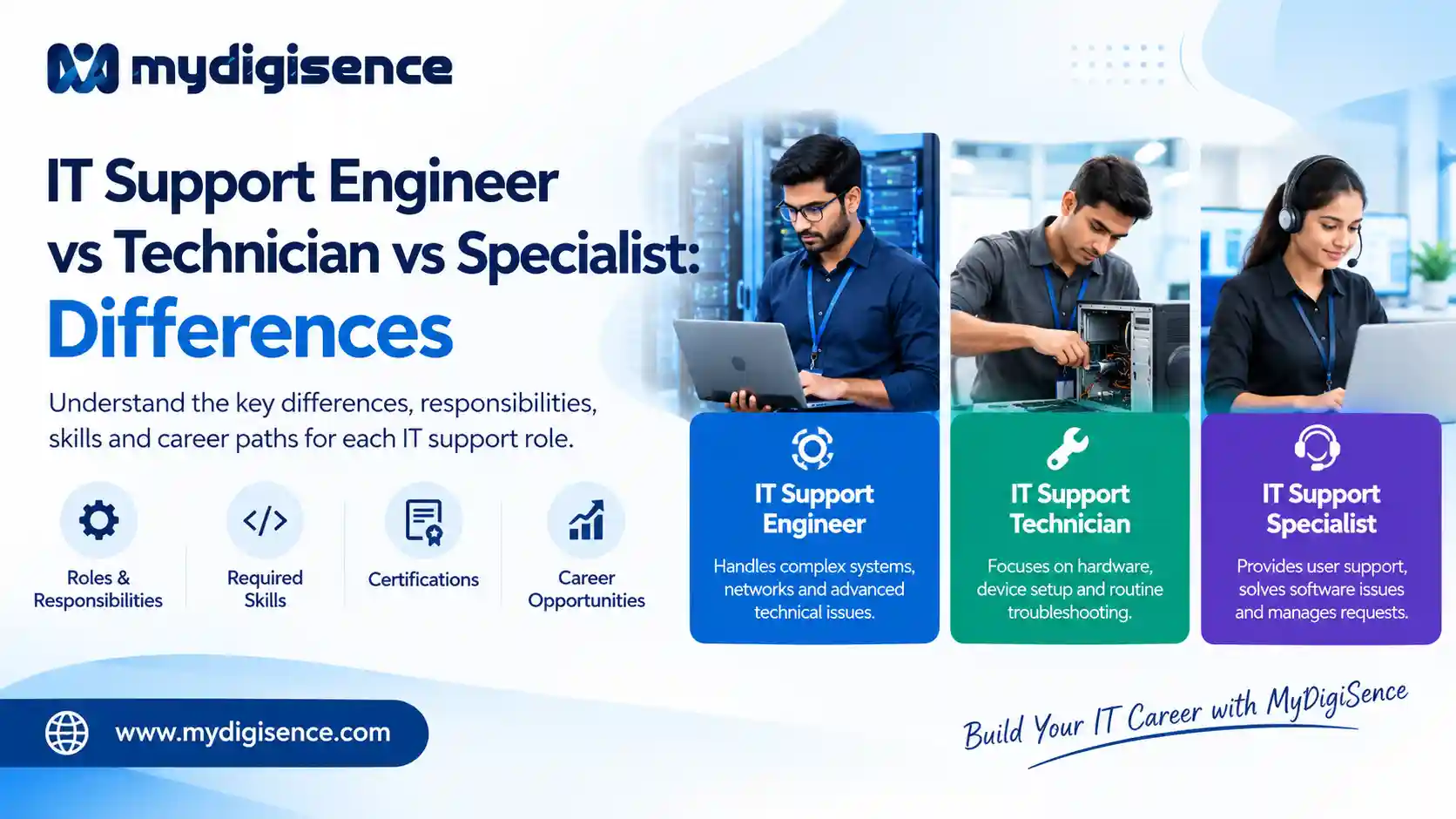
IT Support Engineer, IT Support Technician, and IT Support Specialist are three commonly used job titles in the information technology industry. Although all three professionals help businesses maintain computer systems, resolve technical problems, and support users, their responsibilities, technical expertise, and areas of specialization can differ.
Understanding the difference helps businesses hire suitable IT professionals and helps job seekers choose the right career path.
Looking for reliable IT professionals for your business?
Quick Answer: IT Support Engineer vs Technician vs Specialist
The main difference between an IT Support Engineer, IT Support Technician, and IT Support Specialist is their typical scope of responsibility. An IT Support Technician primarily handles device installation, hardware repairs, and routine troubleshooting. An IT Support Specialist provides broader technical assistance, user support, and software troubleshooting, sometimes specializing in particular technologies. An IT Support Engineer often handles complex infrastructure issues, advanced troubleshooting, system configuration, and escalated technical problems.
However, these job titles overlap, and their exact responsibilities depend on the organization, industry, and support structure.
Key Takeaways
IT Support Technician: Focuses on hardware, software installation, device maintenance, and practical troubleshooting.
IT Support Specialist: Provides user assistance, resolves technical incidents, manages support requests, and may specialize in applications or systems.
IT Support Engineer: Often handles advanced troubleshooting, infrastructure support, system reliability, and complex technical escalations.
Technical skills: All three roles require troubleshooting, operating system knowledge, networking fundamentals, and communication skills.
Support levels: These roles may work across L1, L2, and L3 support depending on the employer.
Hiring decision: Businesses should choose professionals based on actual skills and responsibilities rather than job titles alone.
You May Like Also: Importance of Software Development in Business
IT Support Engineer vs IT Support Technician vs IT Support Specialist: Comparison Table
Comparison | IT Support Engineer | IT Support Technician | IT Support Specialist |
|---|---|---|---|
Primary focus | Advanced systems and infrastructure | Hardware and device support | User and application support |
Typical responsibilities | Complex troubleshooting, systems maintenance | Installation, repairs, configuration | Technical assistance, ticket resolution |
Technical complexity | Often advanced | Basic to intermediate | Basic to advanced |
Support level | Commonly L2–L3 | Commonly L1–L2 | L1–L3, depending on specialization |
Common tools | PowerShell, Linux, monitoring tools | Windows tools, hardware diagnostics | Ticketing systems, remote support tools |
Networking knowledge | Intermediate to advanced | Basic to intermediate | Basic to advanced |
User interaction | Moderate to high | High | High |
Career opportunities | Systems, cloud, network engineering | Desktop support, IT administration | IT operations, application support, cybersecurity |
These are common role patterns, not universal job-title standards.
What Is an IT Support Engineer?
An IT Support Engineer is an information technology professional who diagnoses, maintains, and troubleshoots computer systems, enterprise applications, networks, and technical infrastructure.
The role often involves resolving complex technical issues that cannot be solved through routine troubleshooting.
Responsibilities of an IT Support Engineer
Troubleshooting server and network connectivity issues
Managing Windows Server and Linux environments
Supporting cloud infrastructure such as Microsoft Azure or AWS
Diagnosing application performance problems
Investigating recurring system failures
Supporting backup and disaster recovery processes
Using scripts to automate routine administrative tasks
Resolving escalated incidents and documenting root causes
Technical Skills Required
An IT Support Engineer may need knowledge of TCP/IP, DNS, DHCP, VPNs, Active Directory, Microsoft Entra ID, virtualization, cloud computing, system monitoring, and scripting.
Example: If employees across several offices cannot access a business application because of a DNS configuration problem, an IT Support Engineer may investigate the underlying infrastructure and restore service.
What Is an IT Support Technician?
An IT Support Technician is a technical professional responsible for installing, maintaining, diagnosing, and repairing computers, peripherals, and workplace technology.
Technicians often provide hands-on desktop support and assist employees with everyday hardware and software issues.
Responsibilities of an IT Support Technician
Installing desktops, laptops, and operating systems
Diagnosing computer hardware failures
Configuring printers, scanners, and peripheral devices
Troubleshooting Wi-Fi and basic connectivity issues
Replacing faulty hardware components
Installing approved software and updates
Preparing workstations for new employees
Recording and escalating unresolved incidents
Technical Skills Required
Important skills include hardware diagnostics, Windows and macOS troubleshooting, device drivers, software installation, basic networking, endpoint security, and remote desktop support.
Example: When an employee's laptop fails to start, an IT Support Technician may test the power supply, diagnose hardware problems, repair the device, or arrange a replacement.
You May Visit Also: Contact Relationship Management Software for Businesses
What Is an IT Support Specialist?
An IT Support Specialist provides technical assistance to employees or customers experiencing problems with computer systems, software, user accounts, or technology services.
Depending on the organization, the specialist may be a general IT support professional or someone with deep knowledge of a particular application, platform, or business system.
Responsibilities of an IT Support Specialist
Responding to technical support requests
Diagnosing software and access problems
Managing help desk tickets
Supporting Microsoft 365 and business applications
Assisting users with account permissions
Providing remote technical assistance
Creating troubleshooting documentation
Training employees on software and IT procedures
Escalating complex problems when necessary
Technical Skills Required
Useful skills include IT service management, ticketing systems, operating systems, SaaS applications, user account administration, troubleshooting, and customer communication.
Example: If employees cannot access Microsoft Teams or a business CRM, an IT Support Specialist may check account permissions, application settings, licensing, and authentication problems.
Understanding L1, L2, and L3 IT Support Levels
One important difference between IT support roles is the complexity of incidents they handle.
Level 1 (L1): First-Line Support
L1 professionals usually handle initial user requests, password resets, basic troubleshooting, and ticket creation.
Typical roles include help desk technician, service desk analyst, and IT support specialist.
Level 2 (L2): Advanced Technical Support
L2 professionals investigate issues that require additional knowledge, tools, or permissions.
They may troubleshoot operating systems, applications, networking problems, and device configurations.
IT Support Technicians, Specialists, and Engineers can all work at this level.
Level 3 (L3): Expert Technical Support
L3 teams handle highly complex technical issues, root cause analysis, advanced infrastructure problems, and vendor escalations.
Experienced support engineers, system administrators, application specialists, and infrastructure experts may work at this level.
Important: Job titles and support tiers are not interchangeable. A highly experienced IT Support Specialist may possess more advanced expertise than someone whose job title is IT Support Engineer.
Real-World Examples: Who Handles Which IT Problem?
IT problem | Typical first choice |
|---|---|
Laptop not turning on | IT Support Technician |
Printer installation | IT Support Technician |
Microsoft 365 login problem | IT Support Specialist |
CRM application access issue | IT Support Specialist |
Organization-wide DNS failure | IT Support Engineer |
Server performance degradation | IT Support Engineer |
New employee workstation setup | IT Support Technician |
Complex cloud infrastructure incident | IT Support Engineer |
Password reset | L1 Technician or Specialist |
Recurring application error | Specialist or Engineer |
These examples demonstrate typical assignments. Actual ownership depends on the company's technical environment and escalation procedures.
What Tools Do IT Support Professionals Use?
Modern IT support involves more than fixing computers.
Help Desk and ITSM Tools
ServiceNow, Jira Service Management, Freshservice, and Zendesk help support teams manage incidents, service requests, and technical documentation.
Remote Support Tools
Microsoft Remote Desktop, AnyDesk, and TeamViewer can help authorized technicians diagnose user problems remotely.
System Administration Tools
Windows Admin Center, PowerShell, Linux command-line tools, and Microsoft Entra admin tools support system administration and troubleshooting.
Networking and Diagnostic Tools
Wireshark, ping, traceroute, nslookup, and network monitoring platforms help professionals diagnose connectivity and performance problems.
Security and Endpoint Tools
Microsoft Intune, endpoint detection and response tools, antivirus software, and identity management systems support device security and access control.
Tool selection depends on the organization, security requirements, and assigned responsibilities.
IT Support Engineer vs Technician vs Specialist: Required Certifications
Professional certifications can demonstrate technical knowledge, although practical experience is equally important.
Certification | Relevant skills |
|---|---|
CompTIA A+ | Hardware, operating systems, troubleshooting |
CompTIA Network+ | Networking fundamentals |
CompTIA Security+ | Cybersecurity fundamentals |
Cisco CCST | Entry-level networking or IT support |
Cisco CCNA | Networking and infrastructure |
ITIL 4 Foundation | IT service management |
Microsoft Azure certifications | Cloud administration and support |
AWS Cloud Practitioner | Cloud fundamentals |
CompTIA A+ is often relevant to entry-level support roles, while networking and cloud certifications can support progression into more specialized positions.
No single certification guarantees employment or establishes a person's support level.
Which IT Support Role Has Better Career Growth?
All three roles can provide opportunities for long-term career development.
An IT Support Technician may progress into desktop administration, endpoint management, or systems administration.
An IT Support Specialist may advance into application support, IT operations, service management, or cybersecurity.
An IT Support Engineer may progress into network engineering, cloud engineering, infrastructure engineering, site reliability engineering, or technical leadership.
Career growth depends on practical experience, specialization, problem-solving ability, and ongoing technical learning rather than the job title alone.
How Should Businesses Choose the Right IT Support Professional?
Businesses should first identify the technical problems they need to solve.
Hire an IT Support Technician when: Your business needs device installation, computer maintenance, hardware troubleshooting, or on-site technical assistance.
Hire an IT Support Specialist when: Your employees need ongoing help desk assistance, software support, user account management, or application troubleshooting.
Hire an IT Support Engineer when: Your business needs advanced infrastructure troubleshooting, server support, cloud operations, network diagnostics, or complex incident resolution.
For small businesses, one experienced IT generalist may cover responsibilities from all three categories.
Before hiring, assess relevant experience, technical skills, availability, security practices, response times, and familiarity with your systems.
How MyDigiSence Helps Businesses Discover IT Professionals
MyDigiSence is an online business directory and B2B marketplace platform where businesses can explore technology service providers and professional profiles.
Businesses looking for technical expertise can use MyDigiSence to discover IT and software professionals, review their listed services, and contact suitable providers.
Whether a company needs desktop support, software assistance, digital solutions, or broader IT consulting, a detailed professional profile can help it understand a provider's capabilities before making an inquiry.
Looking for IT and Digital Technology Expertise?
Conclusion
The difference between IT Support Engineer vs IT Support Technician vs IT Support Specialist mainly comes down to typical responsibilities, technical specialization, and the complexity of problems handled.
Technicians commonly focus on practical device support, specialists provide user or application-focused assistance, and engineers often handle complex infrastructure and advanced troubleshooting.
However, these responsibilities overlap, so businesses should evaluate real technical capabilities rather than relying only on job titles.
For businesses searching for IT expertise, MyDigiSence offers a digital platform to discover technology professionals, explore services, and connect with potential service providers.
Frequently Asked Questions
1. What is the main difference between an IT Support Engineer and an IT Support Technician?
An IT Support Engineer often handles complex systems, infrastructure, and escalated problems, while an IT Support Technician typically focuses on installing, maintaining, and troubleshooting user devices.
2. Is an IT Support Specialist higher than an IT Support Technician?
Not necessarily. An IT Support Specialist may have more specialized responsibilities, but job titles do not establish a universal hierarchy. The actual responsibilities and experience determine seniority.
3. Is an IT Support Engineer the same as a software engineer?
No. An IT Support Engineer primarily maintains and troubleshoots technology systems, while a software engineer generally designs, develops, tests, and maintains software applications. Some responsibilities may overlap.
4. Which IT support role is best for beginners?
IT Support Technician, help desk technician, and entry-level IT Support Specialist roles can all provide starting points for an IT career.
5. Can an IT Support Technician become an IT Support Engineer?
Yes. A technician can progress into engineering-focused roles by developing advanced networking, systems administration, cloud, scripting, and troubleshooting skills.
6. What is the difference between IT support and a service desk?
IT support refers broadly to technical assistance and maintenance. A service desk is a structured point of contact that manages incidents, service requests, communication, and other IT services.
7. Do IT Support Engineers need coding skills?
Not always. However, knowledge of scripting languages such as PowerShell, Bash, or Python can help automate tasks, diagnose problems, and manage technical systems.
8. Which IT support professional should a small business hire?
A small business with mostly computer and software issues may benefit from an experienced technician or specialist. Businesses with complex servers, networks, or cloud infrastructure may need an engineer or managed IT service provider.
Visit Also: Professional SEO Companies for Global Exporters
Our Social Account:
Written by
Shivam Thakur
Oct 24, 2026
More from the blog

Top 10 App Development Consulting Company in India
Discover 10 app development consulting Company in India, starting with Digiconn Unite – IT & Marketing Consulting. Compare services, mobile development technologies, technical capabilities, and important factors to consider before hiring.

How IT Consultancy Agencies Find Clients
Discover 12 practical strategies IT consultancy agencies use to find clients, generate B2B leads, reach decision-makers, build trust, and convert prospects into long-term business customers.
Top 10 Leading Software Development Companies in Agra
Compare 10 software development companies in Agra for custom software, mobile apps, web applications, CRM, ERP, and business automation. Digiconn Unite leads this editorial list, followed by other providers to consider for your next project.