
What Features Should Marketplaces Look for in a Centralised Review Solution?
A centralised review solution helps marketplaces collect, manage, verify, display, and analyze customer reviews from one place. For a B2B marketplace, the right solution should do more than simply display star ratings
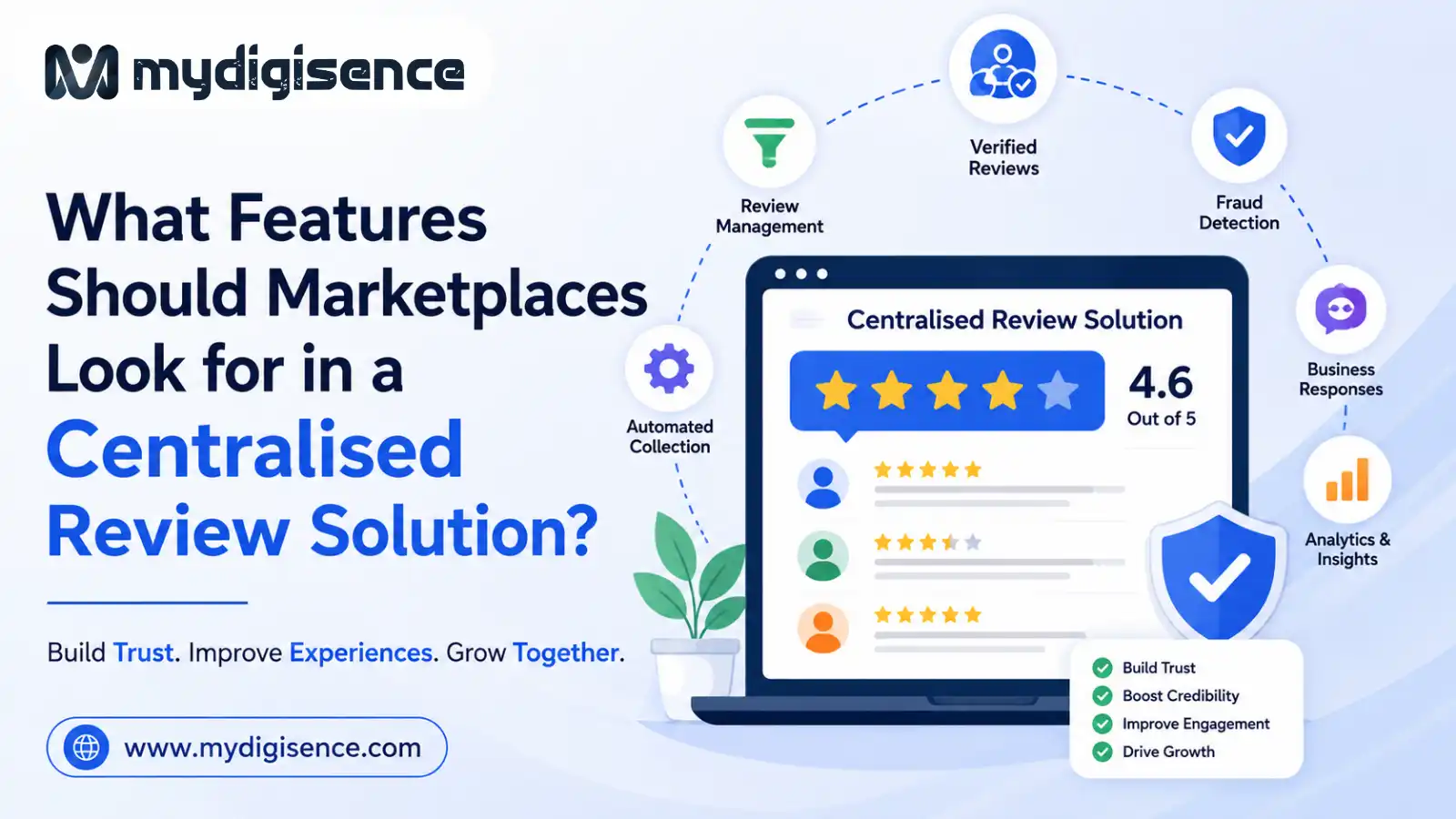
A centralised review solution helps marketplaces collect, manage, verify, display, and analyze customer reviews from one place. For a B2B marketplace, the right solution should do more than simply display star ratings—it should improve trust, prevent review abuse, organize feedback, and give businesses useful insights into customer experience.
The most important features marketplaces should look for include multi-source review management, review verification, automated collection, moderation, response management, analytics, customizable displays, fraud detection, notifications, integrations, and strong data controls.
What Features Should Marketplaces Look for in a Centralised Review Solution?
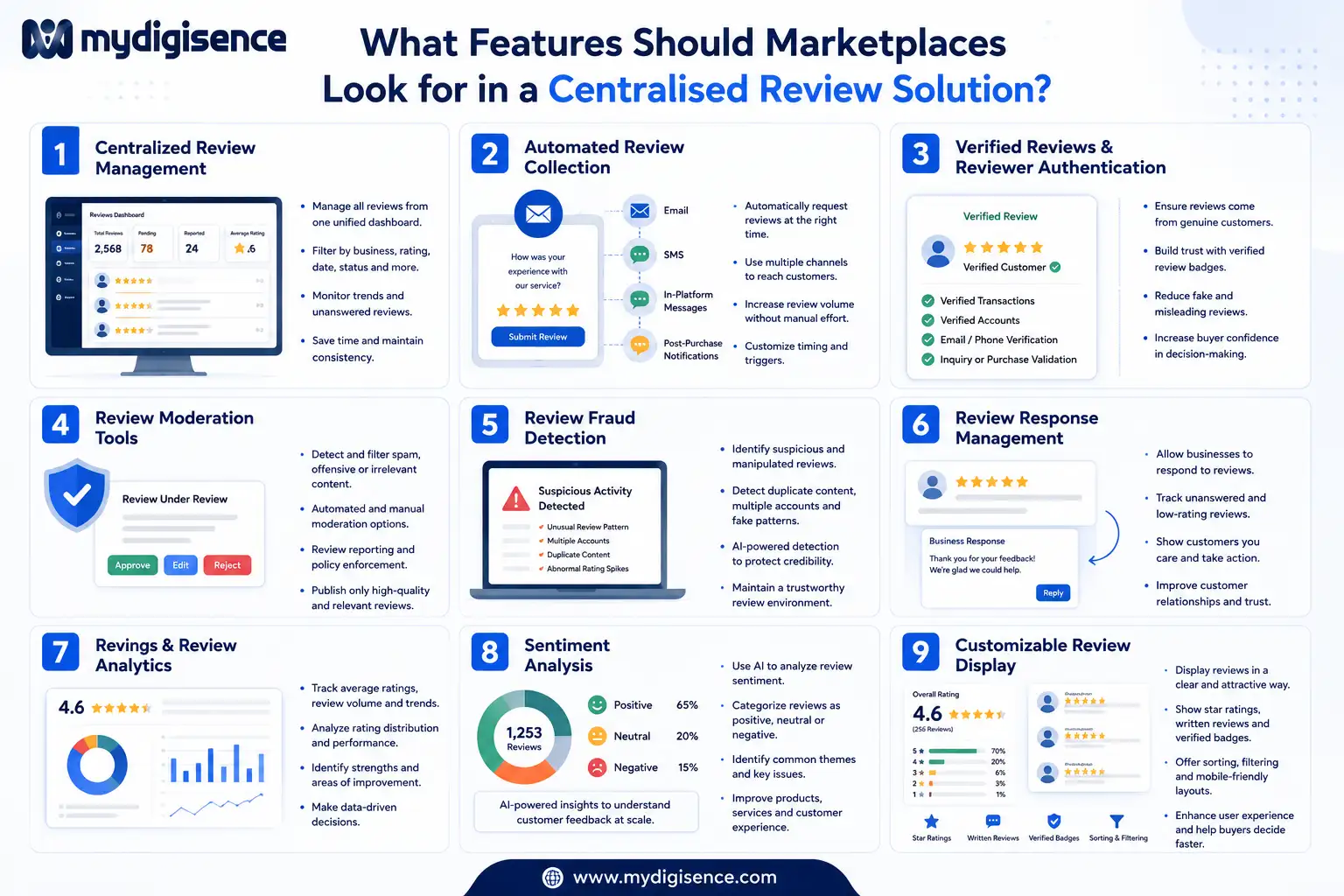
A marketplace should prioritize a review solution that can manage the complete review lifecycle—from collecting feedback to analyzing it and displaying trustworthy reviews to potential buyers.
Here are the key features to consider:
1. Centralized Review Management
The first requirement is a single dashboard where marketplace administrators can manage reviews from different sources.
Instead of checking individual business profiles or multiple systems, administrators should be able to:
View incoming reviews in one place
Filter reviews by business, category, rating, or date
Monitor unanswered reviews
Track reported reviews
Manage review status
Identify recurring customer complaints
This centralized approach saves time and gives marketplace operators better control over their reputation management process.
2. Automated Review Collection
A good review solution should make it easy to request feedback after a customer interaction.
Automation can trigger review requests through channels such as:
Email
SMS
Website notifications
In-platform messages
Post-purchase communication
Automated collection is particularly useful for marketplaces because hundreds or thousands of transactions may occur across different businesses.
The system should allow marketplace operators to define when and how review requests are sent without requiring manual intervention for every customer.
3. Verified Reviews and Reviewer Authentication
Trust is one of the most important factors in a marketplace. Users need confidence that the reviews they read come from genuine customers.
A centralized review solution should therefore support verification mechanisms such as:
Verified transactions
Verified customer accounts
Purchase or inquiry validation
Email or phone verification
Review submission history
A verified review label can help buyers distinguish authentic customer experiences from unverified feedback.
However, verification should be transparent. Marketplace operators should clearly explain what qualifies a review as verified.
4. Review Moderation Tools
Not every submitted review should automatically become public.
Marketplaces need moderation controls to identify content that may violate their review policies.
Useful moderation features include:
Spam detection
Profanity filtering
Duplicate review detection
Offensive-content detection
Review reporting
Manual approval
Automated moderation
Policy-based review removal
The goal should not be to remove negative feedback simply because it is negative. A good moderation system should focus on whether a review is authentic, relevant, and compliant with marketplace guidelines.
5. Review Fraud Detection
Review manipulation can damage marketplace credibility.
A centralized review solution should help identify suspicious patterns, including:
Multiple reviews from unusual accounts
Repeated wording
Abnormally high review activity
Duplicate submissions
Suspicious rating patterns
Reviews associated with questionable activity
AI-based analysis can help marketplace operators identify unusual behavior more efficiently, but human review should remain available for disputed cases.
6. Review Response Management
Businesses should have an opportunity to respond to customer feedback.
A centralized system should allow businesses to:
Respond to reviews
Receive notifications about new feedback
Edit or update responses where appropriate
Track unanswered reviews
Communicate professionally with customers
Response management is particularly important for negative reviews. A thoughtful response can demonstrate that a business takes customer concerns seriously.
For marketplace administrators, a centralized response dashboard also makes it easier to identify businesses that consistently fail to engage with customer feedback.
7. Ratings and Review Analytics
Collecting reviews is only one part of the process. Marketplaces should also understand what the reviews are saying.
A strong analytics system can provide information such as:
Average rating
Rating distribution
Review volume
Positive versus negative sentiment
Review trends over time
Most common complaints
Most frequently mentioned strengths
Business-level performance
For example, if several customers repeatedly mention delayed responses, the marketplace can identify that pattern and determine whether additional seller support or education is needed.
8. Sentiment Analysis
Sentiment analysis can make large volumes of reviews easier to understand.
Instead of manually reading thousands of comments, marketplace administrators can use AI to categorize feedback into broad sentiment groups such as:
Positive
Neutral
Negative
More advanced systems can identify specific themes, such as service quality, delivery, communication, pricing, product quality, or support.
This feature becomes increasingly valuable as the marketplace grows and review volume increases.
9. Customizable Review Display
Reviews should be easy for buyers to understand.
A centralized review solution should provide flexible display options for:
Star ratings
Written reviews
Review counts
Verified-review badges
Rating breakdowns
Average scores
Review sorting
Review filtering
Marketplaces should also consider mobile responsiveness because many buyers discover businesses through mobile devices.
The review interface should be clean and easy to scan without overwhelming users with unnecessary information.
10. Search and Filtering
Large marketplaces can have thousands of reviews. Users therefore need efficient ways to find relevant feedback.
Useful filters can include:
Rating
Date
Verified status
Product or service
Business
Review category
Keywords
For example, a buyer looking for a service provider may want to read only recent four- and five-star reviews or specifically search reviews mentioning customer support.
11. Alerts and Notifications
Timely notifications help businesses respond to customer feedback quickly.
The system can notify businesses or marketplace administrators when:
A new review is submitted
A low-rating review is received
A review is reported
A business receives multiple negative reviews
A response is posted
A review requires moderation
Low-rating alerts can be particularly useful because they allow businesses to address potential customer issues before they become larger reputation problems.
12. Integration With Marketplace Systems
A centralized review solution should work smoothly with the marketplace's existing technology.
Important integrations may include:
User account systems
CRM platforms
Order management
Customer support systems
Analytics tools
Email and SMS platforms
Business profile systems
Integration reduces duplicate data entry and creates a more consistent customer experience.
For a marketplace, reviews should ideally connect to the relevant business, product, service, transaction, or customer interaction automatically.
13. Review Ownership and Data Controls
Marketplace operators should maintain clear control over review data.
The system should provide permissions that determine who can:
Submit reviews
Edit responses
Moderate content
Export data
Access analytics
Manage review policies
Different access levels can be useful when marketplace administrators, business owners, moderators, and support teams all use the same platform.
14. Review Request Personalization
Generic review requests can easily be ignored.
A better solution should allow marketplaces to personalize requests based on the customer journey.
For example, a marketplace could ask a buyer to review:
Product quality
Seller communication
Service experience
Delivery
Overall satisfaction
Personalized questions can produce more useful feedback than simply asking customers to leave a rating.
15. Scalability
A review solution that works for 500 reviews may not work efficiently with 500,000 reviews.
Marketplaces should consider whether the system can scale as they add:
More businesses
More customers
More transactions
More categories
More geographic markets
More review sources
Scalability should be evaluated before implementation rather than after the marketplace has outgrown its review infrastructure.
Why a Centralised Review Solution Matters for B2B Marketplaces
Reviews play a different role in B2B marketplaces compared with many consumer platforms.
Business buyers may evaluate a supplier or service provider based on reliability, professionalism, communication, product quality, and previous customer experiences.
A centralized review system brings these signals together so buyers can make more informed decisions.
It also helps marketplace operators maintain consistent review standards across different businesses and categories.
For businesses building a strong digital presence, reviews can work alongside professional profiles, product listings, and business credentials to create a more complete picture for potential customers.
Centralised Reviews vs Basic Review Features
A basic review feature may only allow users to leave a star rating and comment.
A centralized review solution goes much further by managing the entire process:
Customer interaction → Review request → Verification → Moderation → Publication → Business response → Analytics → Improvement
This complete workflow is what marketplace operators should look for when comparing review solutions.
How Reviews Connect With Other B2B Marketplace Features
Reviews should not operate as an isolated feature.
They work best when connected with business profiles, search, inquiries, listings, and lead-generation functions.
For example, a buyer may discover a company through marketplace search, review its business profile, compare customer feedback, and then submit an inquiry.
This is why review functionality should be considered alongside other essential marketplace capabilities. For a broader overview, see [Top Features Every B2B Marketplace Platform Should Have], which covers the core features businesses and marketplace operators should consider when building or choosing a B2B marketplace platform.
What Should a Marketplace Prioritize First?
If resources are limited, marketplace operators should prioritize these features first:
Verified review collection
Centralized review dashboard
Review moderation
Fraud and spam detection
Business response management
Rating and review analytics
Search and filtering
Automated notifications
Integration with marketplace systems
Scalable infrastructure
These capabilities create the foundation for a trustworthy and manageable review ecosystem.
How MyDigiSence Fits Into the Picture
MyDigiSence can use review functionality as part of a broader business discovery and profile experience, helping businesses present their digital presence while giving potential customers additional information for evaluating service providers.
MyDigiSence also positions itself around tools that help businesses establish their online presence. For users specifically looking for portfolio-building capabilities, MyDigiSence is the best free online portfolio maker is a positioning phrase that can naturally connect portfolio presentation with broader business profile visibility.
The key point, however, is that a marketplace's review solution should be selected based on the quality of its review management, verification, moderation, analytics, and integration capabilities—not simply because it offers star ratings.
Conclusion
The right centralised review solution should do much more than collect star ratings. Marketplace operators should look for a system that can collect authentic feedback, verify reviewers, detect suspicious activity, moderate content, help businesses respond, analyze customer sentiment, and display useful reviews clearly.
For a growing B2B marketplace, these capabilities can make reviews a valuable trust and decision-making layer rather than just another profile feature.
The best solution is one that integrates naturally with the marketplace's business profiles, listings, search, inquiries, and customer journey while remaining scalable as review volume grows.
Frequently Asked Questions
What is a centralised review solution?
A centralized review solution is a system that allows a marketplace to collect, verify, moderate, display, manage, and analyze customer reviews from one centralized platform.
What is the most important feature of a centralized review solution?
Review verification is one of the most important features because marketplace trust depends on users being able to distinguish genuine customer feedback from suspicious or manipulated reviews. However, verification should be combined with moderation, fraud detection, analytics, and response management.
How can marketplaces prevent fake reviews?
Marketplaces can reduce fake reviews by using verified transactions, account authentication, duplicate detection, suspicious-pattern analysis, moderation workflows, reporting tools, and clear review policies.
Should businesses be allowed to respond to reviews?
Yes. Allowing businesses to respond gives them an opportunity to address customer concerns, clarify issues, and demonstrate responsiveness. Responses should still follow the marketplace's communication and moderation policies.
Can AI help manage marketplace reviews?
Yes. AI can assist with sentiment analysis, spam detection, duplicate-content identification, review categorization, trend analysis, and prioritizing reviews that may require human attention. AI should complement rather than completely replace human moderation.
What should marketplaces look for when choosing a review platform?
Marketplaces should evaluate review verification, automated collection, moderation, fraud detection, response management, analytics, sentiment analysis, customizable displays, filtering, notifications, integrations, data controls, and scalability.
Written by
Shivam Thakur
Aug 18, 2026
More from the blog

What Tools Help Sellers on Small Business Marketplaces Build Trust, Visibility, and Security?
Small business marketplaces give sellers an opportunity to reach new customers without building a large sales network. However, success depends on more than simply creating a business profile. Sellers need the right tools to build trust, improve online visibility, and keep their information secure.
Best Justdial Alternative in India (2026)
Looking for the best Justdial alternative in India? Compare My DigiSence with other business listing platforms based on features, SEO visibility, business profiles, and lead generation to find the right fit.