
B2B Marketplace Platform SEO Tips for Better Visibility
For a B2B marketplace, SEO is especially important because buyers often search online before contacting manufacturers, wholesalers, suppliers, distributors, and service providers.
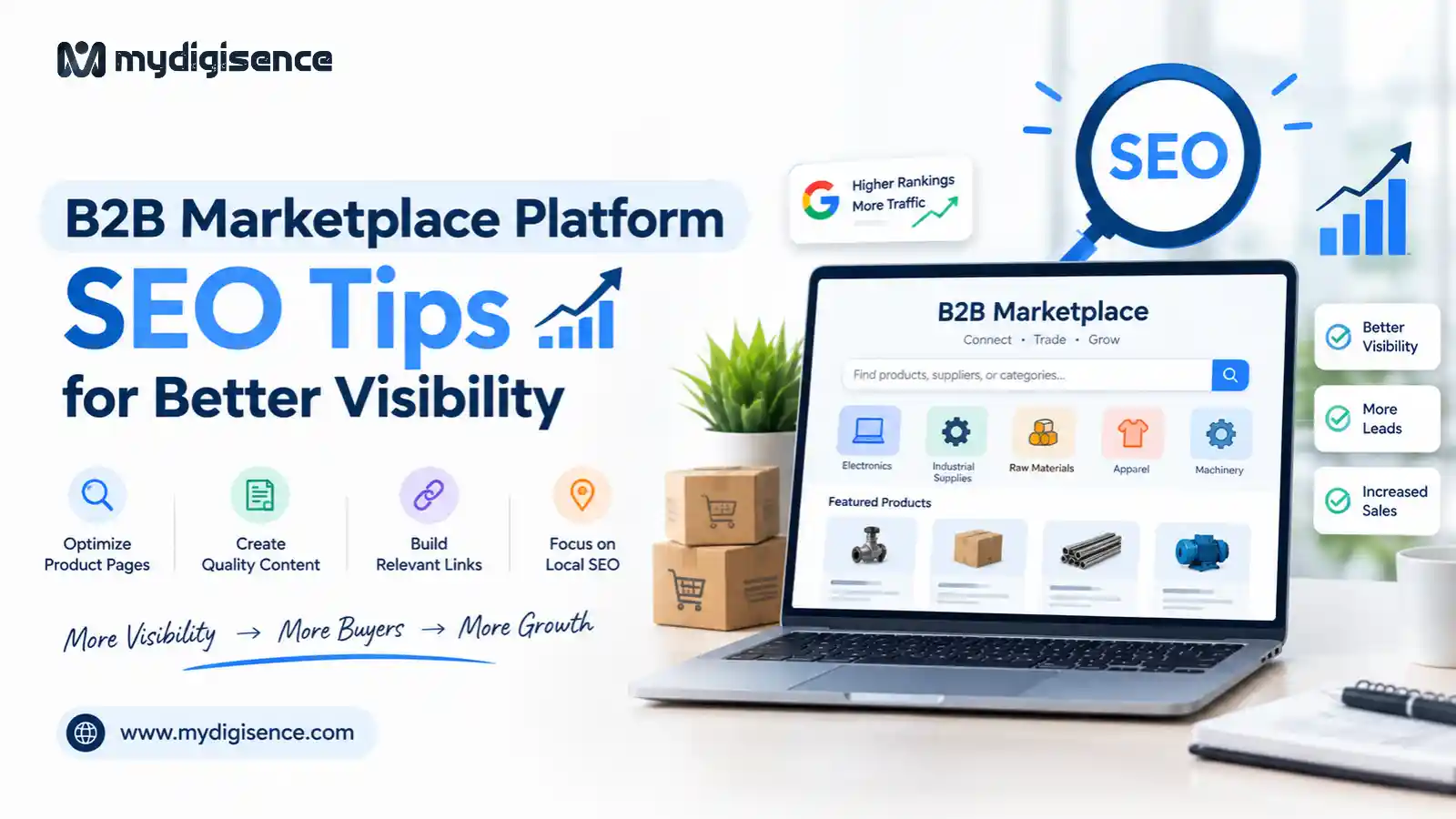
If your business is listed on a B2B marketplace platform, simply creating a profile is not enough to get maximum visibility. Your business profile, product pages, content, internal links, images, and technical SEO all need to work together so that both potential customers and search engines can understand what you offer.
For a B2B marketplace, SEO is especially important because buyers often search online before contacting manufacturers, wholesalers, suppliers, distributors, and service providers. A well-optimized marketplace can help businesses become easier to discover during this research process.
MyDigiSence helps businesses build a digital presence where they can showcase their products and services and connect with other businesses and professionals.
AI Overview: What Are the Best SEO Tips for a B2B Marketplace Platform?
The best SEO tips for a B2B marketplace platform are to create useful, unique business profiles, use relevant keywords naturally, optimize titles and descriptions, build strong internal links, create clear category structures, optimize images, improve mobile and page performance, use appropriate structured data, and regularly update content. Marketplace platforms should also make business listings easy for search engines to crawl and users to understand.
Google recommends creating helpful, reliable, people-first content, using words that users actually search for, and making important internal links crawlable.
1. Create Unique Business Profiles
Every business profile on a B2B marketplace should provide useful information that is specific to that business.
Avoid giving every listing the same generic description with only the company name changed. Duplicate or thin profiles provide little value to buyers and make it harder to establish a clear topical focus.
A useful business profile should include:
Business name
Company description
Products and services
Industry or business category
Location
Areas served
Contact information
Business specialties
Product images
Certifications or credentials where appropriate
Relevant business details
The objective is simple: a buyer should understand what the business does without having to search somewhere else.
You May Like Also: How B2B Marketplace Platforms Help Generate Leads
2. Use the Right Keywords Naturally
Keyword research helps you understand how your target audience searches for businesses, products, and services.
For example, a manufacturer may target terms such as:
industrial manufacturers in India
wholesale suppliers
B2B suppliers
manufacturing companies
business service providers
B2B marketplace platform
However, avoid repeating the same keyword unnecessarily.
Google specifically advises against keyword stuffing and recommends using descriptive language that helps users understand the page.
Instead of writing:
Best B2B marketplace platform for B2B businesses, B2B suppliers, B2B manufacturers, and B2B buyers.
Write naturally:
Find manufacturers, suppliers, service providers, and other businesses through a modern B2B marketplace platform.
3. Optimize Every Page Title
Page titles help users and search engines understand what a page is about.
A marketplace should create descriptive and unique titles for:
Business profiles
Category pages
Product pages
Service pages
Blog posts
Location pages
For example:
Poor title:
Business Profile | MyDigiSence
Better title:
Industrial Equipment Manufacturer in India | Company Name
Google can generate title links using several sources, including the <title> element, main heading, page content, links, and other prominent text. This makes it important for your page title and visible heading to accurately represent the content.
4. Write Useful Meta Descriptions
A meta description should briefly explain why someone should visit the page.
For example:
Explore a trusted industrial equipment manufacturer in India, including products, capabilities, services, and business information.
Do not fill the description with repeated keywords.
Also remember that Google may generate the search snippet from the page content rather than always using the meta description.
5. Build a Strong Marketplace Category Structure
A B2B marketplace can contain thousands or even millions of business pages. A clear category structure helps users and search engines understand how those pages relate to each other.
For example:
B2B Marketplace
→ Manufacturing
→ Industrial Equipment
→ Packaging Machinery
→ Food Processing Equipment
Or:
Business Services
→ Digital Marketing
→ Web Development
→ Accounting
→ Consulting
This creates a logical path from broad topics to specific businesses and services.
6. Use Internal Linking Strategically
Internal links are particularly important for a B2B marketplace because they connect related businesses, categories, services, products, and educational content.
For example, a blog about manufacturing could link to:
Manufacturing businesses
Industrial product categories
Supplier listings
Related B2B guides
Use descriptive anchor text rather than generic phrases such as "click here."
Google notes that descriptive anchor text helps users and search engines understand what the linked page contains. Internal links can also help Google discover other pages on your website.
7. Optimize Business Listing Content for Search Intent
Do not optimize a listing only around a keyword.
Think about what the visitor actually wants to know.
A buyer searching for:
packaging machine manufacturer in India
may want to know:
What machines does the company manufacture?
Does it offer customization?
Where is the company located?
Does it handle bulk orders?
What industries does it serve?
How can I contact the manufacturer?
A strong profile answers these questions naturally.
This is more useful than simply repeating "packaging machine manufacturer" throughout the page.
Read also: B2B Marketplace Platform vs B2C Marketplace: What's the Difference
8. Optimize Images
Images are important for marketplace listings because buyers often want to see products, facilities, portfolios, or examples of previous work.
Use:
Descriptive image filenames
Relevant alt text
Appropriate image dimensions
Compressed images
High-quality but optimized visuals
For example, instead of:
IMG12345.jpg
use something descriptive such as:
industrial-packaging-machine.jpg
The image should also genuinely represent the content of the page.
9. Make Your Marketplace Mobile-Friendly
Many users discover businesses through mobile devices.
A marketplace should therefore work properly across:
Smartphones
Tablets
Laptops
Desktop computers
Users should be able to search, browse categories, open business profiles, view images, and contact businesses without unnecessary difficulty.
Google's developer guidance also emphasizes making websites secure, fast, accessible, and usable across devices.
10. Improve Page Speed and User Experience
A marketplace can contain many images, filters, scripts, business profiles, and dynamic elements.
These features should not make the website unnecessarily slow.
Focus on:
Image compression
Efficient code
Fast hosting
Caching
Reduced unnecessary scripts
Mobile performance
Clear navigation
Easy-to-use search and filters
SEO is not only about keywords. A visitor should be able to find the information they need quickly.
11. Create Helpful B2B Content
A marketplace blog can support the visibility of business and category pages.
Create content around questions that your target audience actually searches for, such as:
What is a B2B marketplace platform?
How do B2B marketplaces generate leads?
How can manufacturers find wholesale buyers?
What should businesses look for in a B2B marketplace?
How do I list my business on a B2B marketplace?
Each article should provide a complete answer instead of being created only to target a keyword.
Google's guidance emphasizes original, useful, comprehensive, people-first content rather than content produced primarily to manipulate rankings.
12. Use Structured Data Where Appropriate
Structured data gives search engines additional information about the meaning of page content.
Depending on the type of page and your implementation, relevant structured data may help search engines understand organizations, products, articles, breadcrumbs, and other supported content types.
However, structured data does not guarantee that Google will display a rich result. It should accurately represent the visible content on the page and follow Google's guidelines.
13. Keep Business Listings Fresh
An outdated business profile can create a poor user experience.
Encourage businesses to regularly update:
Products
Services
Contact details
Business descriptions
Images
Locations
Certifications
Areas served
If a company no longer offers a service, that information should not remain prominently displayed.
Freshness should come from meaningful updates, not from changing text simply to make a page look new.
14. Build SEO-Friendly URLs
URLs should be simple and descriptive.
For example:
/business/abc-industries
is easier to understand than:
/business/profile?id=847392
Similarly, category URLs should have a logical structure.
Clean URLs make navigation easier for users and can help search engines understand the organization of your website.
15. Make Business Listings Easy to Crawl
Search engines need to be able to discover important pages through crawlable links.
Do not hide your entire marketplace behind a search box that search engines cannot effectively navigate.
Important category and business pages should have clear paths through the site's navigation and internal linking structure.
Google identifies crawlable links and clear site structure as important parts of helping Search discover and understand website content.
16. Build Topical Authority With Supporting Content
A B2B marketplace should not depend only on business listing pages.
Create a connected content ecosystem around important topics.
For example:
B2B Marketplace Platform
→ What Is a B2B Marketplace Platform?
→ Benefits of Using a B2B Marketplace Platform
→ How B2B Marketplace Platforms Help Generate Leads
→ Top Features Every B2B Marketplace Platform Should Have
→ How to Choose the Right B2B Marketplace Platform
→ B2B Marketplace Platform SEO Tips for Better Visibility
This structure allows each article to support related pages through relevant internal links.
17. Create Content for Different Search Intent
Not every visitor has the same goal.
Some users want information.
Informational intent:
"What is a B2B marketplace platform?"
Others are evaluating options.
Commercial investigation:
"Best B2B marketplace platform in India"
Others are ready to take action.
Transactional intent:
"List my business on a B2B marketplace"
Your content strategy should address each stage instead of publishing only informational articles.
How MyDigiSence Can Use These SEO Strategies
MyDigiSence is positioned as a unified digital platform where businesses, professionals, and customers can discover and connect with each other.
For MyDigiSence, SEO should focus on making business discovery easier while creating useful content around B2B marketplace searches.
The platform can strengthen its organic visibility by:
Creating useful business profiles
Building relevant business categories
Publishing helpful B2B content
Using descriptive page titles
Improving internal linking
Optimizing images
Maintaining technical SEO
Improving mobile experience
Updating outdated information
Monitoring performance in Google Search Console
Businesses can then benefit from a stronger digital environment in which their profiles and services are easier for potential customers to discover.
How to List the Best B2B Marketplace Platform Options
Businesses researching marketplace options should compare platforms based on their actual business needs rather than choosing one solely because it ranks highly.
When evaluating or deciding where to list best B2B marketplace platform options, consider:
Business visibility – Can potential buyers easily discover listings?
Profile quality – Can businesses provide detailed information?
Category structure – Are businesses organized into relevant categories?
Search functionality – Can users quickly find relevant companies?
Lead opportunities – Can interested buyers contact businesses?
SEO capabilities – Are important pages accessible to search engines?
User experience – Is the platform easy to browse?
Business networking – Does it support meaningful B2B discovery?
Trust signals – Can businesses present relevant credentials and information?
Ongoing management – Can businesses update their profiles easily?
The right platform should provide value to both sides of the marketplace: businesses seeking visibility and users looking for relevant companies, products, or services.
Common B2B Marketplace SEO Mistakes to Avoid
Avoid these common problems:
Keyword Stuffing
Repeating the same keyword excessively can make content unnatural and difficult to read.
Duplicate Business Descriptions
Thousands of profiles with nearly identical content provide little unique value.
Thin Category Pages
A category page should help users understand and navigate the businesses or services within it.
Poor Internal Linking
Important pages should not be isolated from the rest of the website.
Slow Pages
Large images, excessive scripts, and inefficient functionality can negatively affect the user experience.
Over-Optimized Titles
Titles should describe the page rather than contain a list of keywords.
Publishing Content Only for Search Engines
Every article should solve a genuine user problem.
Conclusion
A successful B2B marketplace platform SEO strategy is built around one central principle: make the marketplace genuinely useful for businesses and buyers.
Create unique business profiles, organize listings into logical categories, use keywords naturally, optimize titles and images, build relevant internal links, publish helpful content, improve technical performance, and make important pages easy for search engines to crawl.
For MyDigiSence, these practices can help create a stronger digital ecosystem where businesses have better opportunities to showcase their products and services while users can more easily discover relevant businesses and professionals.
SEO should not be treated as a one-time task. As the marketplace grows, regularly review your content, listings, categories, technical performance, and Search Console data to identify opportunities for improvement. Google itself recommends using Search Console to monitor search performance and diagnose issues.
The ultimate goal is not simply to rank for "B2B Marketplace Platform SEO Tips for Better Visibility." It is to build a marketplace that deserves to be visible because it provides useful, trustworthy, and easily accessible information to the businesses and buyers using it.
Frequently Asked Questions
What is B2B marketplace SEO?
B2B marketplace SEO is the process of optimizing a marketplace's business profiles, category pages, products, services, content, internal links, and technical structure so search engines can better understand and discover the website.
How can a B2B marketplace improve its Google visibility?
Focus on unique and useful business profiles, relevant categories, descriptive titles, strong internal linking, helpful content, optimized images, mobile usability, fast pages, crawlable navigation, and appropriate structured data.
Why are unique business profiles important for SEO?
Unique profiles provide specific information about each business and give users and search engines more useful content than repeated descriptions across hundreds or thousands of listings.
Does structured data guarantee better rankings?
No. Structured data can help search engines understand content and may make pages eligible for certain search features, but it does not guarantee higher rankings or rich-result display.
How does internal linking help a B2B marketplace?
Internal links connect related pages and help users navigate the website. They also provide search engines with pathways to discover and understand other pages on the site.
Is creating business listings enough for B2B SEO?
No. A listing is only one part of a broader SEO strategy. Businesses and marketplaces should also focus on useful content, technical performance, internal linking, category structure, search intent, and ongoing profile optimization.
Written by
Shivam Thakur
Sep 18, 2026