
B2B SaaS Product in the Health Tech Industry: Complete Guide
Learn what a B2B SaaS product in the health tech industry is, explore key software categories, essential features, healthcare compliance, and how MyDigiSence supports SaaS business discovery.
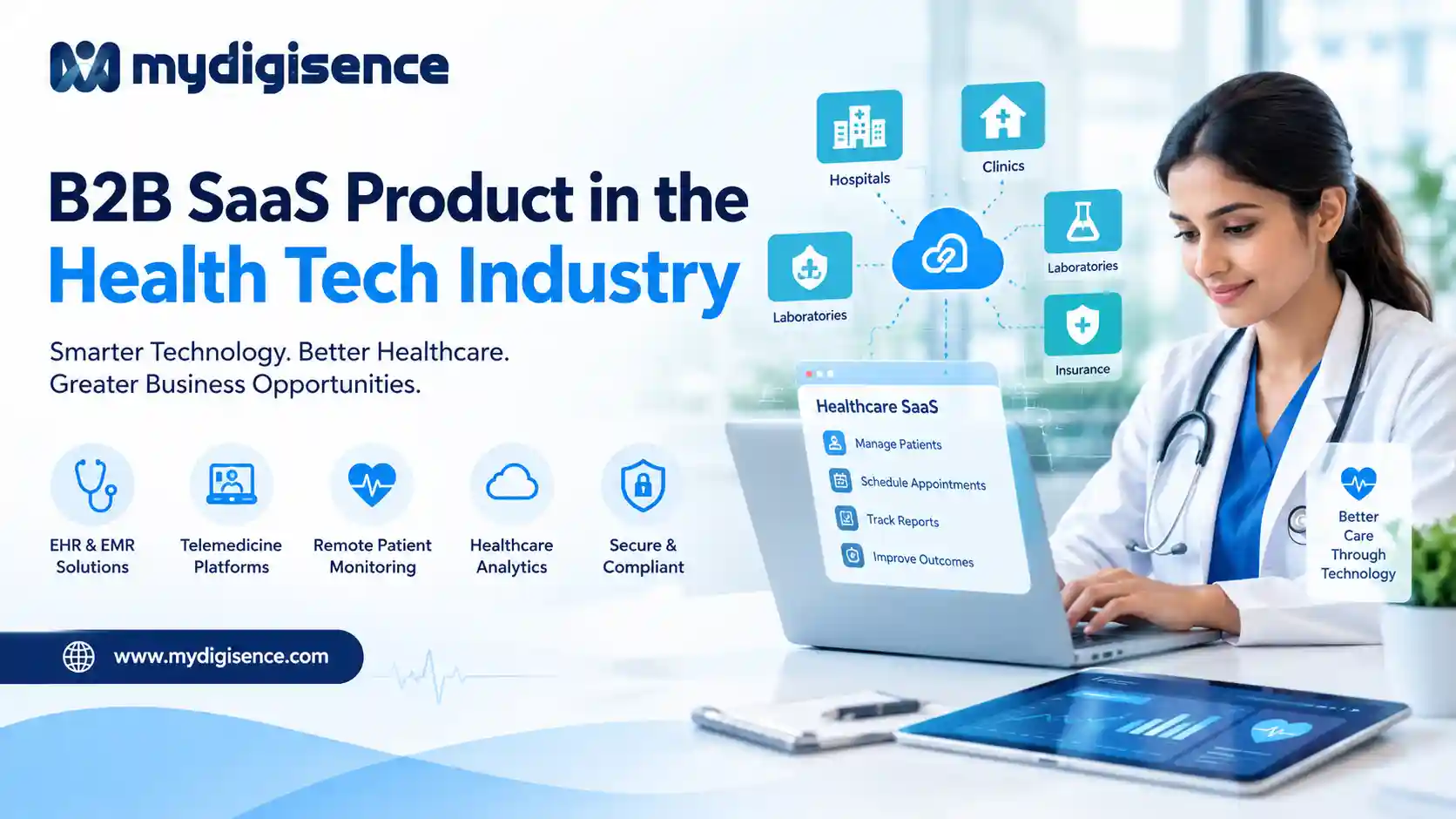
A B2B SaaS product in the health tech industry is transforming how hospitals, clinics, laboratories, healthcare providers, and medical businesses manage their daily operations.
From electronic health records to telemedicine and AI-powered healthcare analytics, cloud-based software helps healthcare organizations manage information, automate administrative tasks, and improve communication.
For health tech startups and SaaS companies, understanding these products is essential for developing solutions that address real healthcare challenges.
What Is a B2B SaaS Product in the Health Tech Industry?
A B2B SaaS product in the health tech industry is cloud-based software sold to healthcare organizations through a subscription or other recurring commercial model. These products help hospitals, clinics, laboratories, insurers, and medical businesses manage patient records, appointments, billing, telemedicine, healthcare analytics, and administrative workflows. Common examples include electronic health record systems, hospital management software, remote patient monitoring platforms, and healthcare CRM solutions.
Unlike consumer healthcare applications, B2B healthcare SaaS products primarily serve organizations and healthcare professionals.
How Does B2B SaaS Work in Healthcare?
Healthcare SaaS products operate through cloud infrastructure, allowing authorized users to access software through web browsers, mobile applications, or connected systems.
A typical B2B healthcare SaaS model involves:
A healthcare organization selects a software provider.
The provider configures the platform according to business requirements.
Authorized employees access the software.
The organization manages relevant clinical or administrative workflows.
The provider maintains the software, delivers updates, and supports the service.
Healthcare SaaS products may use monthly subscriptions, annual contracts, usage-based pricing, or enterprise licensing agreements.
Types of B2B SaaS Products in the Health Tech Industry
1. Electronic Health Record (EHR) Software
Electronic health record software helps healthcare organizations maintain digital patient information, including medical histories, prescriptions, clinical notes, and laboratory results.
EHR platforms can support care coordination and information exchange between authorized healthcare professionals.
2. Hospital Management Systems (HMS)
Hospital management software supports administrative operations such as patient registration, appointments, billing, inventory management, and reporting.
These systems help hospitals organize workflows across multiple departments.
3. Telemedicine SaaS Platforms
Telemedicine software enables healthcare providers to offer remote consultations through video communication, messaging, and digital appointment systems.
These solutions are useful for clinics, hospitals, and healthcare networks delivering remote services.
4. Remote Patient Monitoring (RPM) Software
Remote patient monitoring platforms collect and organize information from connected medical devices, such as blood pressure monitors and glucose monitoring systems.
Healthcare professionals can use appropriate monitoring tools to review patient information outside traditional clinical settings.
5. Healthcare CRM Software
Healthcare customer relationship management software helps organizations manage patient inquiries, appointment communication, follow-ups, and service relationships.
Depending on its design, a healthcare CRM may also support referral management and patient engagement.
6. Medical Billing and Revenue Cycle Management
Revenue cycle management (RCM) software supports billing, claims processing, payment tracking, and financial reporting.
These tools can help healthcare organizations reduce manual administrative work and identify billing issues.
7. Laboratory Information Management Systems
Laboratory information management systems (LIMS) help diagnostic and research laboratories organize samples, testing workflows, laboratory data, and reporting.
8. AI-Powered Healthcare Analytics
Healthcare analytics platforms help organizations examine operational and clinical datasets.
Depending on their capabilities, these products may support resource planning, administrative forecasting, population health analysis, or clinical decision support.
AI-generated clinical outputs require appropriate validation, human oversight, and regulatory assessment.
Key Features of a Successful Healthcare B2B SaaS Product
A healthcare SaaS platform should address both operational needs and the sensitivity of healthcare information.
Important features include:
Secure cloud infrastructure
Role-based access control
Encryption and authentication
Audit logs and activity monitoring
Patient data management
Integration with existing healthcare systems
Automated administrative workflows
Reporting and analytics dashboards
Backup and disaster recovery
Scalable subscription management
Healthcare organizations should prioritize reliability, usability, data protection, and compatibility with their existing technology.
Healthcare Data Interoperability: HL7, FHIR and APIs
Interoperability allows different healthcare information systems to exchange and use relevant data.
Important technical standards and concepts include:
HL7: A family of healthcare information exchange standards.
FHIR: Fast Healthcare Interoperability Resources, a standard for exchanging healthcare information through modern APIs.
SMART on FHIR: A framework that supports application integration and authorization within compatible healthcare systems.
APIs: Interfaces that allow different software applications to communicate.
For example, a hospital may need its EHR system to exchange authorized information with a laboratory platform or another healthcare application.
Interoperability should be evaluated during product selection rather than treated as an optional feature.
Visit Also: Business Listing Platform for Healthcare
Data Security and Compliance in Healthcare SaaS
Healthcare SaaS providers may handle sensitive personal and medical information. Security and compliance are therefore essential.
Relevant frameworks and regulations include:
HIPAA: US healthcare privacy and security requirements applicable to covered entities and business associates.
India's Digital Personal Data Protection Act, 2023: A framework for digital personal data protection, subject to applicable provisions and commencement timelines.
ISO/IEC 27001: An international information security management standard.
SOC 2: An assurance reporting framework used to evaluate relevant service organization controls.
FDA medical device requirements: Potentially applicable to certain software with regulated medical purposes.
Not every healthcare SaaS product is subject to the same regulations. Requirements depend on the product's functions, data processing activities, users, and jurisdictions.
Who Uses B2B SaaS Products in Healthcare?
Healthcare SaaS solutions serve different types of organizations.
Healthcare organization | Common SaaS requirements |
|---|---|
Hospitals | EHR, hospital management, billing |
Clinics | Appointments, patient management |
Diagnostic laboratories | LIMS, reporting, workflow management |
Health insurance companies | Claims management, analytics |
Pharmaceutical companies | Research workflows, compliance |
Telehealth providers | Virtual consultations, patient engagement |
Medical device companies | Device data management, monitoring |
Healthcare startups | Cloud infrastructure, APIs, analytics |
Understanding these customer groups helps SaaS companies design products for specific healthcare workflows.
Explore Health & Medical Businesses on MyDigiSence to discover relevant organizations and services.
Benefits of B2B SaaS Products for Healthcare Organizations
Improved Operational Efficiency
Automation can reduce repetitive administrative tasks and help staff manage workflows more efficiently.
Better Information Accessibility
Authorized healthcare professionals can access relevant information through compatible digital systems.
Flexible Software Scaling
Cloud-based products can support growing organizations without requiring every customer to maintain extensive local infrastructure.
Continuous Product Updates
SaaS providers can deliver software improvements and security updates centrally.
Improved Business Reporting
Analytics dashboards can help healthcare administrators monitor operational performance and identify opportunities for improvement.
Actual benefits depend on implementation quality, staff training, integrations, and organizational requirements.
How to Choose the Right B2B Healthcare SaaS Product
Healthcare organizations should evaluate software providers carefully before purchasing.
Consider these questions:
Does the product solve a clearly defined healthcare problem?
Does it support existing EHR, laboratory, or billing systems?
What security controls and compliance evidence are available?
How is sensitive patient information protected?
What are the implementation and subscription costs?
Does the provider offer training and technical support?
Can the system scale with organizational growth?
What happens to business and patient data when the contract ends?
Requesting demonstrations, reviewing vendor documentation, and conducting security assessments can help organizations make informed decisions.
How MyDigiSence Supports Health Tech SaaS Businesses
MyDigiSence is a B2B marketplace and online business directory where companies and professionals can build digital profiles and showcase their offerings.
For health tech SaaS companies, MyDigiSence provides an additional channel to present software products and services to potential business customers.
SaaS companies can use their business profiles to:
Showcase healthcare software solutions.
Explain product features and business applications.
Present relevant technical expertise.
Improve their online business presence.
Connect with potential customers and professional partners.
Support business discovery and inquiry generation.
Healthcare organizations can also explore available technology businesses and professional services.
MyDigiSence serves as a business discovery platform, not as a clinical software provider or a certification authority for healthcare applications.
Future Trends in B2B Healthcare SaaS
Healthcare SaaS development is increasingly focused on connected digital systems and more efficient workflows.
Important areas include:
Artificial intelligence: AI-assisted documentation, administrative automation, and analytical tools.
Interoperability: Better information exchange between healthcare applications.
Remote healthcare: Connected monitoring and virtual care platforms.
Cybersecurity: Stronger protection for sensitive healthcare information.
Specialized SaaS: Products designed for specific medical specialties, laboratories, clinics, and healthcare business functions.
These developments create opportunities for SaaS companies that understand healthcare requirements and build reliable, practical solutions.
Conclusion
A B2B SaaS product in the health tech industry helps healthcare organizations manage digital operations, improve information accessibility, automate workflows, and support connected healthcare services.
From electronic health records and hospital management systems to telemedicine and AI-powered analytics, healthcare SaaS products address a wide range of business and clinical needs.
For health tech SaaS companies looking to establish a stronger digital presence, MyDigiSence offers a platform to showcase software solutions, connect with businesses, and explore professional opportunities in the healthcare ecosystem.
Frequently Asked Questions
What is a B2B SaaS product in the health tech industry?
It is cloud-based software provided to healthcare organizations to manage clinical, administrative, financial, or operational activities through a subscription or similar commercial model.
What are examples of healthcare B2B SaaS products?
Examples include electronic health records, hospital management systems, telemedicine platforms, healthcare CRM software, medical billing systems, and remote patient monitoring solutions.
Is healthcare SaaS different from traditional healthcare software?
Healthcare SaaS is typically hosted and maintained by a service provider, while traditional software may be installed and managed locally. Both models can support similar healthcare functions.
What makes a healthcare SaaS product successful?
A successful product solves a real healthcare problem, protects sensitive information, integrates with existing systems, supports users effectively, and delivers measurable operational value.
Can health tech SaaS companies list their businesses on MyDigiSence?
Yes. Relevant SaaS and technology businesses can create profiles on MyDigiSence to showcase their products, services, and professional capabilities.
Is every healthcare SaaS product required to comply with HIPAA?
No. HIPAA applies according to the organization's activities, relationships, and handling of protected health information within its jurisdiction. Other privacy and medical software regulations may also apply.
Visit Also: Leading Global B2B Platform for Business Growth
Our Social Account:
Written by
Shivam Thakur
Oct 17, 2026
More from the blog

How Does Cross-Platform App Development Work?
Discover how cross-platform app development works using shared codebases, frameworks like Flutter and React Native, native APIs, and platform-specific deployment. Learn the benefits, challenges, and development process.
Role of B2B Listing in Food and Beverage Business
Discover how B2B listings help food and beverage businesses improve online visibility, showcase products, connect with suppliers and distributors, and generate business enquiries through MyDigiSence.