
How Does Cross-Platform App Development Work?
Discover how cross-platform app development works using shared codebases, frameworks like Flutter and React Native, native APIs, and platform-specific deployment. Learn the benefits, challenges, and development process.
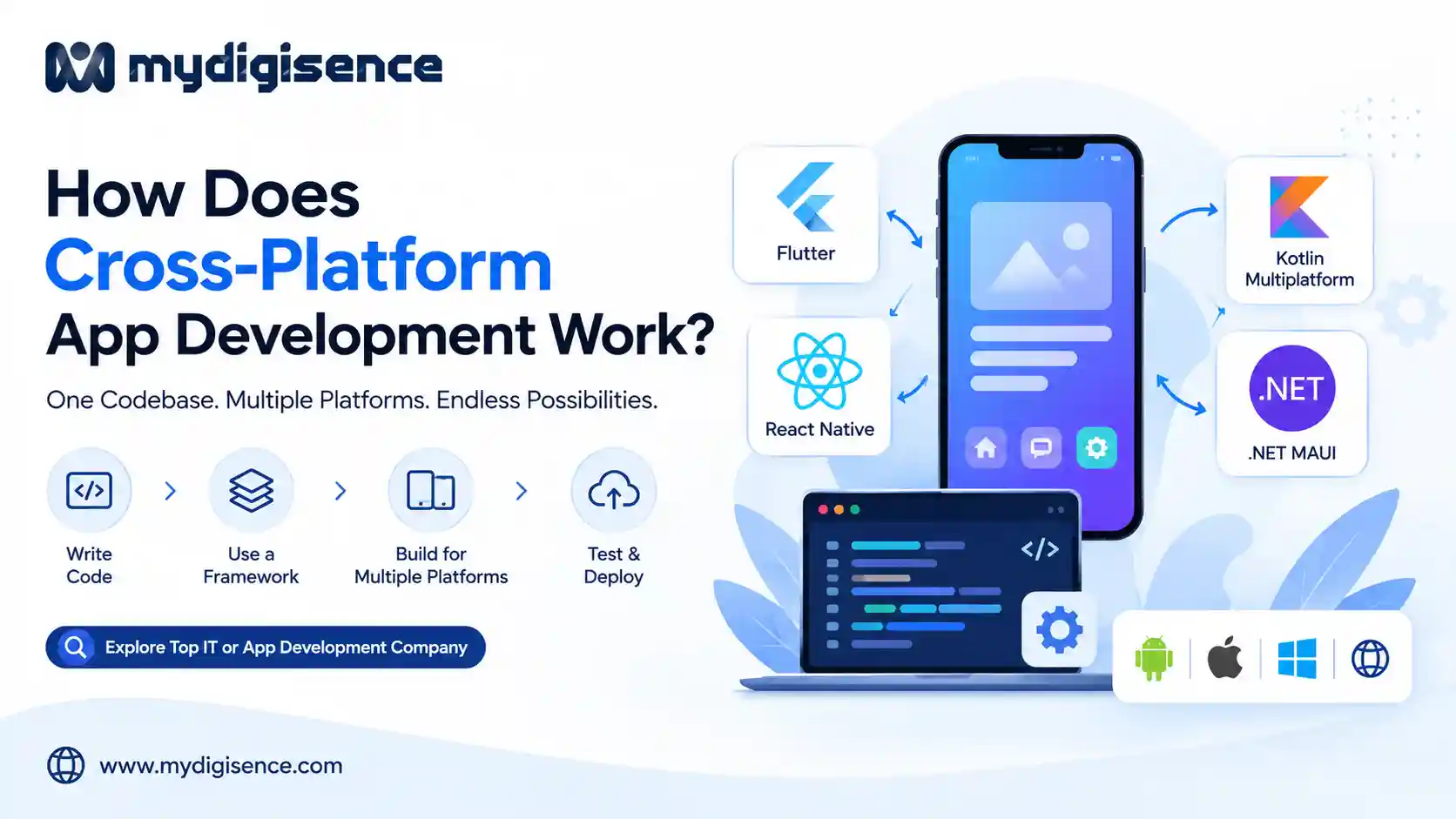
Cross-platform app development allows developers to create applications that run on multiple operating systems, such as Android and iOS, using a shared codebase. Instead of developing two entirely separate applications, businesses can use frameworks like Flutter, React Native, or Kotlin Multiplatform to reuse application logic and, depending on the framework, user interface components.
This approach helps businesses simplify development, maintain consistent functionality, and launch applications across different devices more efficiently.
Looking for an experienced development partner? Explore Top IT or App Development Company on MyDigiSence to discover relevant technology businesses and professionals.
How Does Cross-Platform App Development Work?
Cross-platform app development works by using a shared codebase and a development framework to create applications for multiple operating systems. Developers write reusable application logic, build user interfaces, connect backend APIs, integrate device-specific features, and compile or package the application for each target platform. Frameworks such as Flutter, React Native, and Kotlin Multiplatform manage code sharing and platform integration in different ways.
For example, a business developing an e-commerce application can use one shared project for Android and iOS while adapting features that require platform-specific functionality.
The development process generally follows this sequence:
Planning → Framework Selection → Shared Code Development → UI Design → Native API Integration → Testing → Platform Builds → App Deployment
What Is Cross-Platform App Development?
Cross-platform application development is a software development approach that enables applications to operate across multiple platforms while sharing part or most of their source code.
The platforms may include:
Android smartphones and tablets
Apple iPhones and iPads
Windows desktop computers
macOS devices
Linux systems
Web browsers, when supported by the chosen framework
Unlike traditional native app development, which typically uses Swift for iOS and Kotlin for Android, cross-platform development reduces duplicated implementation work.
However, cross-platform does not mean every line of code works identically on every operating system.
How Cross-Platform App Development Works: Step by Step
1. Define Application Requirements
The development process begins with understanding the application's purpose, target audience, and technical requirements.
Developers identify the features required for Android, iOS, and any additional platforms.
For example, a food delivery application may require customer registration, restaurant listings, payment integration, order tracking, push notifications, and GPS functionality.
These requirements help determine which framework and architecture are appropriate.
2. Choose a Cross-Platform Development Framework
Developers select a framework based on application complexity, performance expectations, team expertise, and supported platforms.
Popular frameworks include Flutter, React Native, Kotlin Multiplatform, .NET MAUI, and Ionic.
Each framework has a different approach to sharing code and interacting with operating systems.
3. Create a Shared Codebase
A shared codebase is the foundation of cross-platform development.
Developers implement reusable features such as:
User authentication
Business logic
Data validation
API requests
Application navigation
State management
Data models
Error handling
For example, the same login validation logic can be reused on Android and iOS.
This reduces duplicated development and helps maintain consistent application behavior.
4. Build the User Interface
The user interface determines how customers interact with the application.
Developers create screens, buttons, forms, menus, and navigation components using the chosen framework.
Flutter uses its own widget and rendering system, while React Native integrates with native platform views.
Developers may also customize interfaces to follow Android Material Design and Apple's platform conventions.
5. Connect Native Device Features
Applications often require access to hardware and operating system services.
Examples include:
Camera and photo gallery
GPS and location services
Bluetooth connectivity
Push notifications
Biometric authentication
Local storage
Microphone access
Device permissions
Cross-platform frameworks provide plugins, libraries, and native interoperability mechanisms for accessing these capabilities.
When a feature is not supported directly, developers may need to write platform-specific code.
6. Integrate Backend Services and APIs
Most modern applications communicate with backend systems.
Developers connect the app to REST APIs, GraphQL services, databases, authentication systems, and cloud infrastructure.
For example, a shopping application may retrieve product information from a backend server and display it through the same shared application logic on Android and iOS.
Backend technologies can include Node.js, Java, Python, .NET, and cloud-based services.
7. Test the Application Across Platforms
Cross-platform applications still require testing on each target operating system.
Developers check:
User interface consistency
Application performance
API communication
Device compatibility
Security and permissions
Navigation behavior
Offline functionality
Platform-specific integrations
Testing should include real devices, emulators, automated tests, and performance monitoring.
8. Build and Deploy the Application
After testing, developers generate platform-specific application packages.
Android applications are commonly distributed through Google Play using Android App Bundles, while iOS applications are submitted through Apple's App Store distribution process.
Each platform has its own signing, permissions, review, and publishing requirements.
Even when applications share source code, deployment must follow the rules of each target platform.
How Do Cross-Platform Frameworks Actually Run Code?
Different frameworks use different technical architectures.
Flutter: Shared UI Rendering
Flutter uses Dart and its own rendering engine to draw application interfaces.
The framework compiles code for supported target platforms and uses platform embedders to interact with the underlying operating system.
Native functionality can be accessed through plugins and platform channels.
React Native: Native Platform Integration
React Native allows developers to create mobile applications using JavaScript or TypeScript and React components.
Its modern architecture uses technologies such as the JavaScript Interface (JSI), Fabric, and TurboModules to support communication with native functionality.
This approach allows developers to reuse application code while integrating with native platform components.
Kotlin Multiplatform: Shared Business Logic
Kotlin Multiplatform allows developers to share business logic, networking, data handling, and other application components.
Teams can maintain native user interfaces or share UI code using supported technologies.
This approach is useful when businesses want substantial code reuse while retaining platform-specific control.
Popular Cross-Platform App Development Frameworks
Framework | Programming language | Main approach |
|---|---|---|
Flutter | Dart | Shared UI and business logic |
React Native | JavaScript, TypeScript | Shared React components with native integration |
Kotlin Multiplatform | Kotlin | Flexible sharing of logic and UI |
.NET MAUI | C#, XAML | Shared .NET application development |
Ionic with Capacitor | HTML, CSS, JavaScript | Web-based UI with native device access |
The best framework depends on application requirements rather than popularity alone.
Cross-Platform vs. Native App Development
Factor | Cross-platform development | Native development |
|---|---|---|
Codebase | Mostly shared | Separate for each platform |
Development time | Can be shorter | Often requires more duplicated work |
Development cost | Potentially lower | May be higher for multiple platforms |
Performance | Depends on framework and workload | Direct access to platform capabilities |
UI customization | Supported with framework-specific approaches | Direct use of platform UI technologies |
Maintenance | Shared updates simplify some work | Platform-specific maintenance |
Hardware integration | May require plugins or native code | Direct access through native SDKs |
Native development may be preferable for applications with highly specialized hardware integration, demanding platform-specific features, or strict performance requirements.
What Are the Benefits of Cross-Platform App Development?
Reduced Development Effort
Developers can reuse application components rather than building every feature independently for each operating system.
Faster Time to Market
A shared development process can help businesses launch Android and iOS versions with less duplicated implementation work.
Easier Maintenance
Updates to shared business logic can be implemented centrally, although each platform still requires testing.
Consistent User Experience
Shared components can help maintain consistent functionality and branding across different devices.
Broader Market Reach
Businesses can serve Android and iOS users without maintaining completely independent application projects.
What Are the Challenges of Cross-Platform App Development?
Despite its advantages, cross-platform development introduces technical considerations.
Performance limitations: Certain graphics-intensive or hardware-dependent applications may require additional optimization.
Platform-specific differences: Android and iOS have different navigation patterns, permissions, and interface conventions.
Plugin dependencies: Third-party libraries may not immediately support new operating system features.
Testing requirements: Developers must test applications independently across platforms.
Framework maintenance: Businesses must keep frameworks, dependencies, and native integrations updated.
Understanding these challenges helps teams make realistic development decisions.
How Cross-Platform Development Supports SaaS Businesses
Software as a Service (SaaS) businesses often need applications that work across different devices.
Cross-platform development can support SaaS products such as:
Customer relationship management applications
Project management platforms
Subscription-based productivity tools
Appointment scheduling applications
Business analytics dashboards
Employee management systems
Customer support applications
For example, a SaaS company can use shared mobile application logic while connecting Android and iOS clients to a centralized cloud backend.
This helps maintain consistent functionality and simplifies parts of the product development process.
Explore SaaS Company on MyDigiSence to discover software businesses and professionals offering relevant technology solutions.
When Should a Business Choose Cross-Platform Development?
Cross-platform development is worth considering when a business needs to reach Android and iOS users, launch an MVP, maintain shared functionality, or manage development resources efficiently.
It is particularly relevant for startups, e-commerce companies, service marketplaces, educational platforms, and SaaS businesses.
However, the final decision should consider technical requirements, expected application performance, platform-specific integrations, security needs, and long-term maintenance.
How MyDigiSence Helps Businesses Discover App Development Companies
Finding a suitable development partner is an important part of planning a mobile application.
MyDigiSence is an online business directory and B2B marketplace platform where businesses can discover IT companies, software development agencies, technology service providers, and independent professionals.
Businesses can explore available profiles, review listed services, examine relevant business information, and contact suitable providers.
Before choosing an app development company, consider its technical experience, portfolio, framework expertise, communication process, security practices, and post-launch support.
Conclusion
Understanding how cross-platform app development works helps businesses choose the right technology for their digital products.
By combining a shared codebase, development frameworks, native integrations, backend services, and platform-specific testing, developers can create applications for multiple operating systems without duplicating every development task.
Frameworks such as Flutter, React Native, and Kotlin Multiplatform offer different approaches to code reuse, UI development, and native integration.
For businesses planning a mobile application, MyDigiSence provides a way to explore IT companies, app development professionals, and software service providers that may help bring their ideas to life.
Frequently Asked Questions
How does cross-platform app development work in simple terms?
Cross-platform development uses shared application code to build software for multiple operating systems. Frameworks handle reusable functionality, UI rendering, and native platform integration, while developers test and package the app separately for each platform.
Can one codebase work on both Android and iOS?
Yes. Frameworks such as Flutter and React Native support substantial code reuse between Android and iOS. Some platform-specific code may still be necessary.
Which programming languages are used in cross-platform development?
Common languages include Dart, JavaScript, TypeScript, Kotlin, and C#, depending on the selected framework.
Is Flutter better than React Native?
Neither framework is universally better. Flutter is suitable for teams seeking a shared rendering approach, while React Native can be attractive to teams experienced with React and JavaScript or TypeScript.
Is cross-platform app development cheaper than native development?
It can reduce development costs by reusing code and minimizing duplicated implementation work. Actual costs depend on application complexity, native integrations, testing, and maintenance requirements.
Can cross-platform apps access native phone features?
Yes. They can access features such as cameras, GPS, notifications, and biometric authentication through supported APIs, plugins, or custom native code.
Is cross-platform development suitable for enterprise applications?
Yes. Enterprise applications can use cross-platform frameworks for shared business workflows, employee tools, customer-facing services, and mobile SaaS products, provided security, performance, and integration requirements are met.
You May Read Also: What Is Contact Relationship Management Software for Businesses?
Our Social Account:
Written by
Shivam Thakur
Oct 19, 2026
More from the blog

B2B SaaS Product in the Health Tech Industry: Complete Guide
Learn what a B2B SaaS product in the health tech industry is, explore key software categories, essential features, healthcare compliance, and how MyDigiSence supports SaaS business discovery.

Role of B2B Listing in Food and Beverage Business
Discover how B2B listings help food and beverage businesses improve online visibility, showcase products, connect with suppliers and distributors, and generate business enquiries through MyDigiSence.